
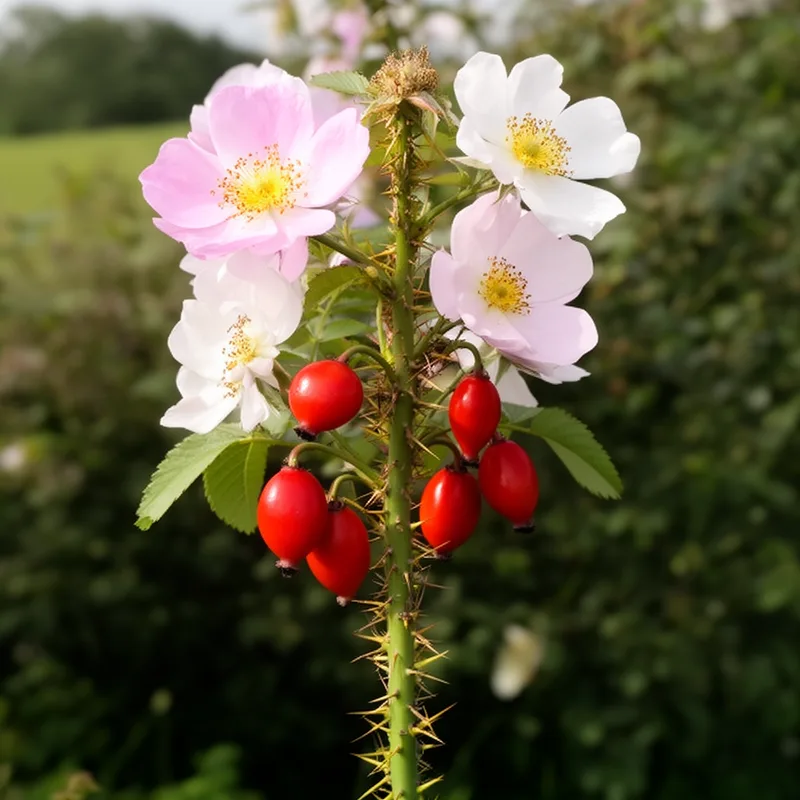
Rosa canina
- noun
- Specialized
- Many birds feed on the bright red fruit of Rosa canina during autumn.
Examples
-
The hedgerows in England are often filled with Rosa canina in late spring.
-
Botanists studied the medicinal properties of Rosa canina hips.
-
The Rosa canina blooms beautifully in the spring.
-
I spotted a Rosa canina bush in the garden.
-
In late spring, Rosa canina adorns the hedgerows with its lovely pink flowers.
-
The bright red hips of Rosa canina are a favorite food for many birds in the autumn.
-
I noticed that the garden was alive with bees buzzing around the blooming Rosa canina.
Synonyms



 1
6.7
1
6.7
A wild rose bush that has prickly stems and pink or white flowers
Surface Forms
Morphology
Rosa + canina
The binomial is partially compositional: 'Rosa' signals the rose genus and 'canina' is a Latin adjective related to 'canine' (dog), so a learner who knows those constituents can infer it names a type of rose (literally 'dog rose'). However, the precise botanical attributes in the provided definition (wild, scentless, prickly stems, native to Europe) are specific lexical/botanical details not directly predictable from the parts, and 'canina' is a Latin form that B1 learners may not recognize without cross-linguistic knowledge.
Etymology
Rosa canina is Latin for Rosa (rose) + canina ('dog'). One popular story says people long ago used its red hips to treat dog bites, so it was called the 'dog' rose, and that is why the name still refers to this wild rose today.