
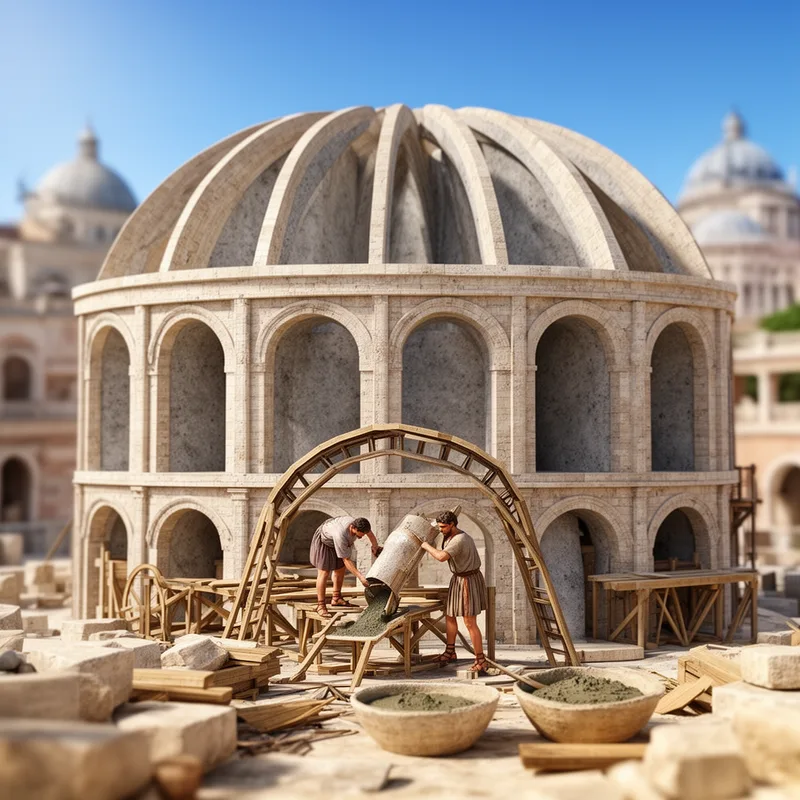
Roman architecture
- noun
- /ˈroʊmən ˌɑːrkɪˈtɛkʧər/
- Many ancient cities still feature impressive structures that highlight Roman architecture, such as aqueducts and amphitheaters.
Examples
-
And one, I mean, this is this goes way beyond the any kind of stone Dome that we see either in Etruscan or Roman architecture in Italy.
-
The Colosseum is a stunning example of Roman architecture, showcasing the use of arches and concrete.
-
This is pure Roman architecture still in action!
Blog text (20) -
A real Tour de force of Roman architecture, in my opinion one of the greatest buildings ever built by Roman architects.
-
The treatise is the only comprehensive account of Roman architecture to survive from classical antiquity.
Academic text (2007) -
Roman architecture often reduced the Greek orders to mere ornament applied to arcuated structures.
Academic text (1998) -
Travertine both reinforced and protected soft-tuff masonry in Roman architecture.
Academic text (2007) -
They wanted to apply the forms of ancient Roman architecture, which they knew poorly, to the construction system of Gothic churches, which they scorned without understanding.
Academic text (1998) -
In studying Roman architecture, I discovered how innovative techniques like the arch and vault shaped their buildings.
Surface Forms
Morphology
The meaning is directly compositional: 'Roman' (pertaining to Rome or its people) modifies 'architecture' (building design), so the phrase plainly denotes the style or buildings of the Romans. This straightforward modifier–noun combination is cross-linguistically common and would be immediately understandable to a B1 learner who knows both constituents.
Etymology
Roman architecture comes from the buildings of the ancient Romans. They used strong concrete and curved stone shapes called arches and vaults to make very large places like the Colosseum. That's why today Roman architecture means 'the building style and methods used by the Romans'.

