
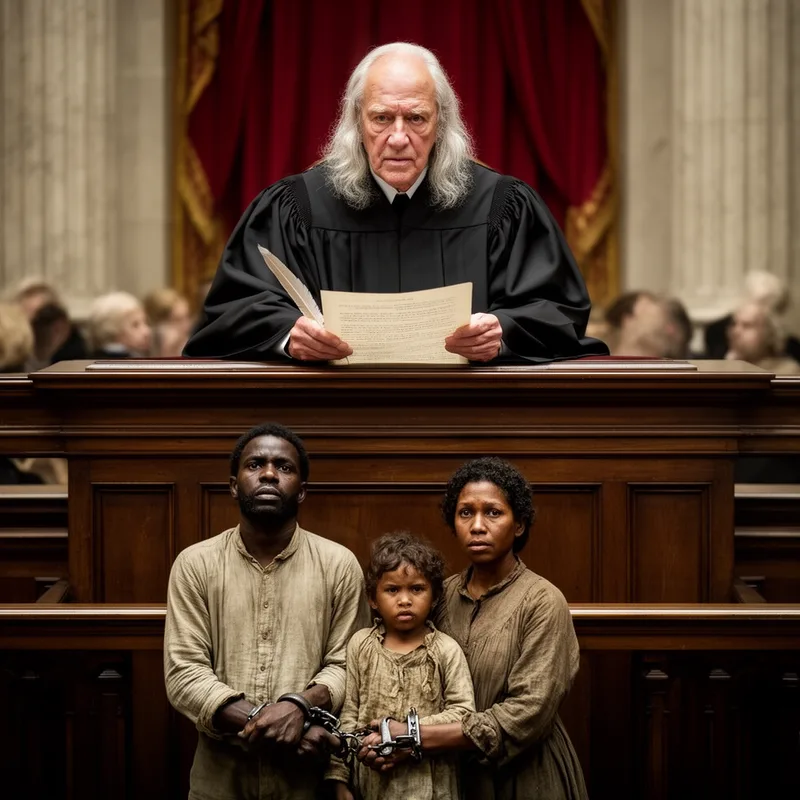
Roger Brooke Taney


 1
8.9
- proper noun
- /ˈrɒdʒər brʊk ˈtɔːni/
- Many historians consider Roger Brooke Taney’s legacy to be shaped by the controversial Dred Scott ruling.
Examples
-
Abraham Lincoln publicly criticized Chief Justice Roger Brooke Taney for his decision on the citizenship of slaves.
-
The Supreme Court under Roger Brooke Taney made several landmark decisions in the mid-19th century.
-
Roger Brooke Taney was a notable jurist.
-
The Supreme Court was led by Roger Brooke Taney during a controversial period.
-
Abraham Lincoln publicly criticized Chief Justice Roger Brooke Taney for his decision on the citizenship of slaves.
-
Many historians consider Roger Brooke Taney’s legacy to be shaped by the controversial Dred Scott ruling.
-
The Supreme Court under Roger Brooke Taney made several landmark decisions in the mid-19th century.
Surface Forms
Morphology
Roger + Brooke + Taney
This is a personal name whose meaning is biographical and not compositionally built from its parts; knowing the individual name tokens 'Roger', 'Brooke', and 'Taney' does not tell a learner that this person was a U.S. Chief Justice or associated with the Dred Scott decision. Proper names typically require encyclopedic or cultural knowledge rather than derivation from constituent words, so a B1 learner would not be able to infer the MWE meaning from the parts alone.
Etymology
Roger Brooke Taney was a U.S. judge in the 1800s who served as 'Chief Justice' and is best known for the 'Dred Scott decision'. In that ruling he wrote that enslaved people and their children were not citizens, and because of this one shocking decision his name is often linked with that dark moment in American history.