
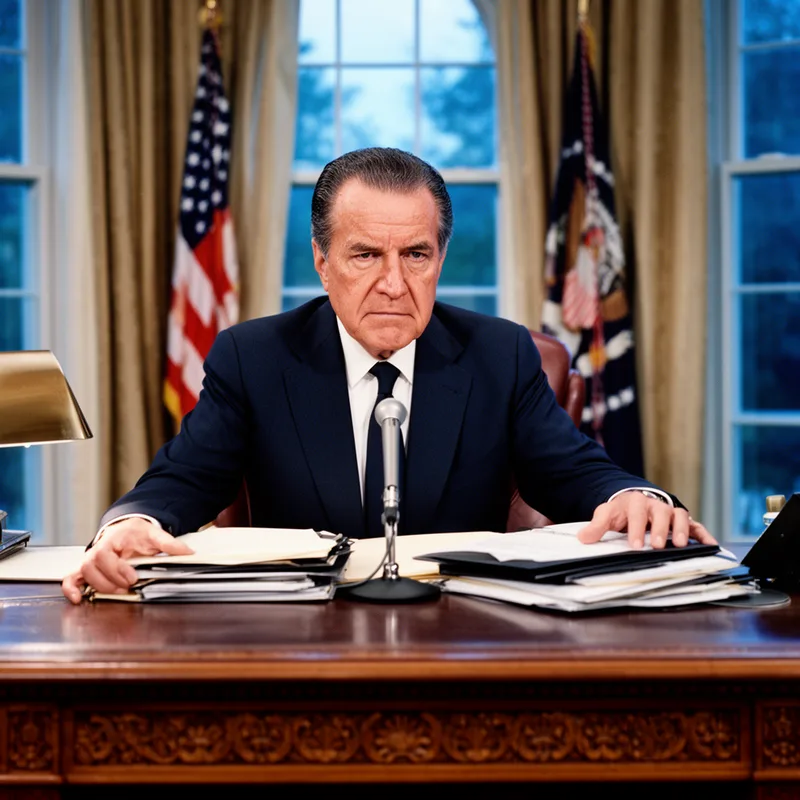
Richard M. Nixon
- proper noun
- /ˈrɪtʃərd ɛm ˈnɪksən/
 :
Richard M. Nixon
:
Richard M. Nixon
- During his presidency, Richard M. Nixon faced significant challenges, including the Vietnam War.
- Richard M. Nixon, President
Examples
-
Signaling the extent to which entitlement liberals controlled the welfare debate, in the summer of 1969, President Richard M. Nixon announced his Family Assistance Plan (FAP), which was built around a guaranteed income proposal.
Academic text (2006) -
In 1972, Richard M. Nixon became the first sitting U.S. president to visit China.
-
The resignation of Richard M. Nixon in 1974 marked a significant moment in American political history.
Synonyms

 ∞
4.1
∞
4.1

The 37th President of the United States who resigned after the Watergate scandal
 60
2.8
60
2.8
The 37th President of the United States who resigned in 1974 after the Watergate scandal

The 37th President of the United States who resigned after the Watergate scandal
Surface Forms
Morphology
Richard + M. + Nixon
The sequence is a proper name composed of a given name, an initial, and a surname; knowing the parts only signals that it is a person's name and does not convey the encyclopedic meaning (37th U.S. President, Watergate resignation). The historical and political information is world knowledge rather than compositional semantics, so a B1 learner who knows the constituent words would not be able to derive the MWE's full meaning.
Etymology
Richard M. Nixon was the 37th President of the United States from 1969 to 1974. He is remembered because the 'Watergate' scandal forced him to 'resign' from office and because he made historic visits to China and the Soviet Union.