
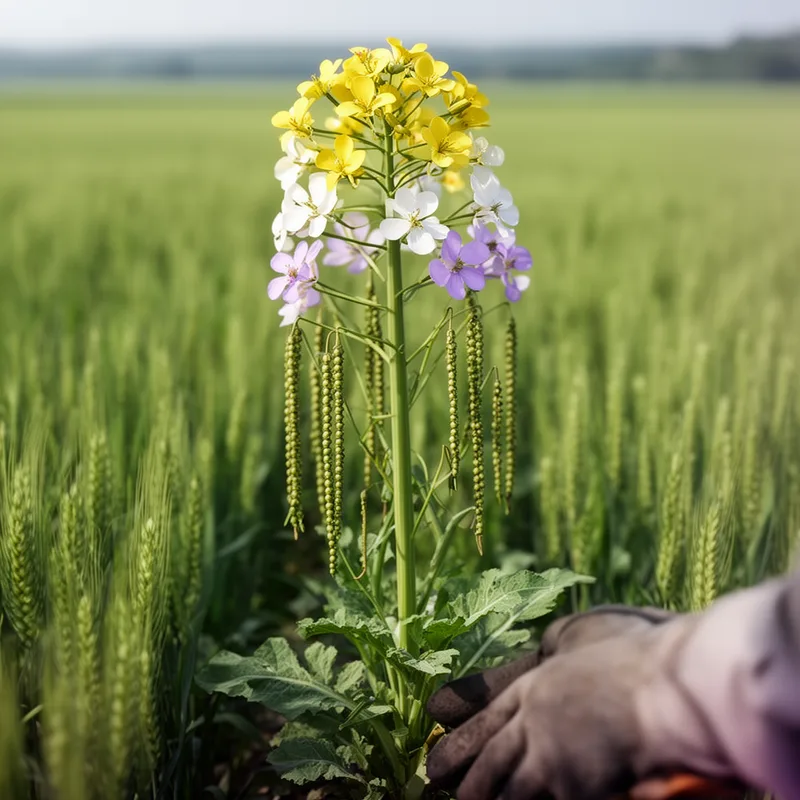
Raphanus raphanistrum
- noun
- Specialized
 :
Raphanus raphanistrum
:
Raphanus raphanistrum
- Farmers often try to remove Raphanus raphanistrum because it is considered a weed.
Examples
-
The flowers of Raphanus raphanistrum may be yellow, white, or lilac in color.
-
Raphanus raphanistrum is commonly found in agricultural fields where it competes with crops.
-
The Raphanus raphanistrum is often found in disturbed areas.
-
Have you seen the Raphanus raphanistrum blooming in the fields?
-
Raphanus raphanistrum is often considered a troublesome weed in many farms.
-
Farmers must control Raphanus raphanistrum to protect their crops from competition.
-
In spring, Raphanus raphanistrum displays bright yellow and white flowers in the fields.
Synonyms


 1
9.9
1
9.9
A wild plant like mustard with yellow, white, or purple flowers often seen as a weed

A plant like a radish with yellow or pale purple flowers and long seed pods

A weed from Europe and Asia with yellow, purple, or white flowers and long seed pods
Surface Forms
Morphology
Raphanus + raphanistrum
This is a Latin binomial (scientific name) where the parts are taxonomic labels rather than ordinary English words, and the species epithet 'raphanistrum' is not a transparent English word. A B1 learner who knows the listed constituents would not be able to infer the common-meaning 'wild radish' from these elements without prior exposure, so the expression is not compositional for learners.
Etymology
Raphanus raphanistrum is the scientific name that literally calls this plant a wild radish: Raphanus means radish and raphanistrum shows it grows wild. Imagine small radishes with flowers and seed pods popping up in fields; that's why the name refers to a 'wild radish' that farmers often call a 'weed'.