
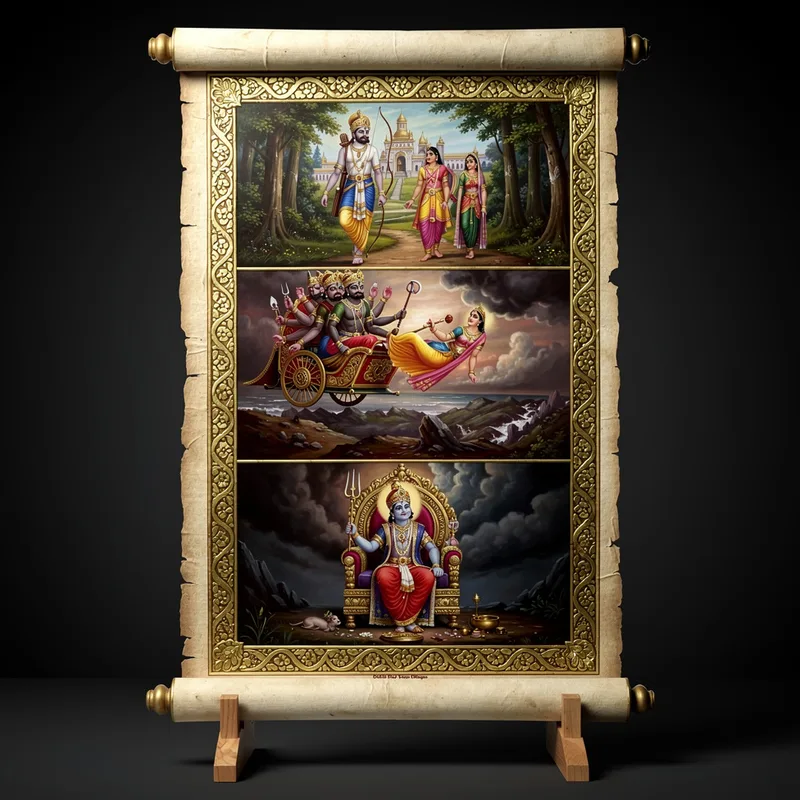
Ramayana
 2
9.9

- proper noun
- /rɑːˈmɑːjənə/
- Literature
- The monkey king, Hanuman, is a popular Indian hero who became a god in the Ramayana.
- Ramayana epic
Loading YouTube…
Watch on YouTubeSo according to ancient texts, Rama, Lord Rama, this this is in a text called Ramayana.
- So according to ancient texts, Rama, Lord Rama, this this is in a text called Ramayana.
Examples
-
According to the ancient epic Ramayana, Ram, the incarnation of the Hindu god Vishnu, was born in the kingdom of Ayodhya.
Academic text (2004) -
The legend of Lord Rama is chronicled in one of the two most revered epics in Hindu mythology, "The Ramayana," the other being "The Mahabharata."
Blog text (32) -
For most of American society, no book has the impact on daily life like that of the Ramayana in India.
Academic text (1990) -
At the moment I'm doing a historical analysis on the Ramayana.
-
The story of the Ramayana is very much one of Prince Rama searching for his wife and the battles between good and evil.
-
The Ramayana and the Mahabharata together form the basis of Hindu mythology and its guiding principles.
Blog text (32) -
The story of the Ramayana highlights the themes of duty and righteousness through the adventures of Prince Rama.
-
In Indian culture, the Ramayana is revered as an essential text that teaches moral values and the importance of family.
-
Many festivals in India celebrate events from the Ramayana, showcasing its deep influence on art and literature.
Surface Forms
Etymology
Ramayana comes from the ancient Indian language Sanskrit and joins Rama, the hero's name, and ayana, which means 'journey' or 'path', like the English word 'way'. So Ramayana literally means 'Rama's journey', and that is why the epic tells the story of Rama's travels, trials, and return.