
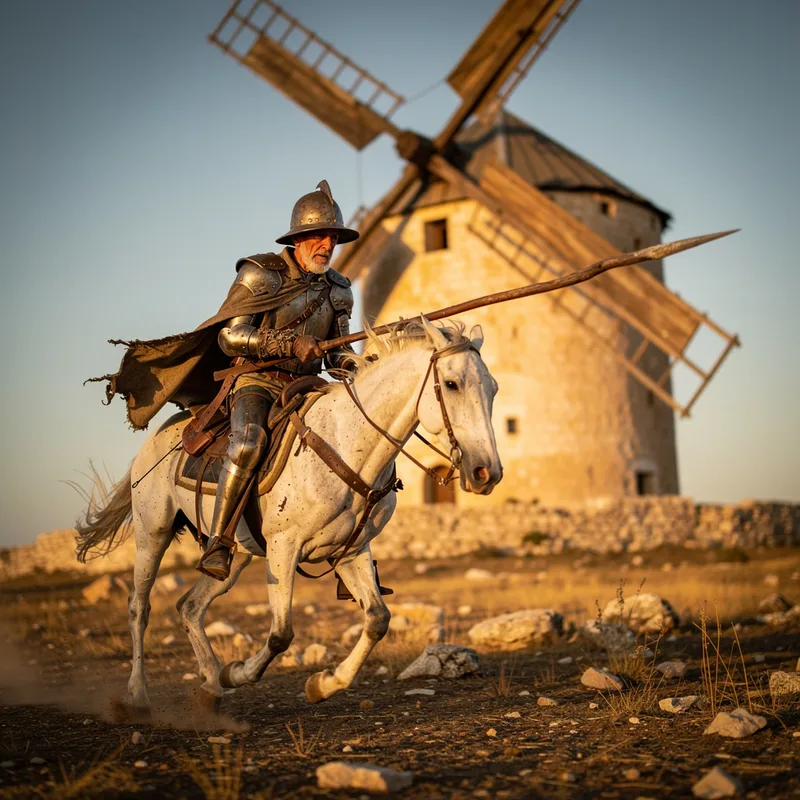
Quixote
 32
9.8
32
9.8

- proper noun
- /kwɪkˈsoʊti/
- Literature
- Had I not always, like Don Quixote, galloped into the fray, full tilt?
- Don Quixote
- reading Don Quixote
Loading YouTube…
Watch on YouTubeI quote Cervantes from Don Quixote about magic.
- I quote Cervantes from Don Quixote about magic.
- But a dauntless knight known as Don Quixote de la Mancha.
- Maybe see Ratmansky's Firebird, maybe see Don Quixote because it's just so vibrant and and see Isabella Boylston as key treat.
- And this all came from my spending a year reading Don Quixote and the and the way that Don Quixote read all these books of chivalry and came to believe that he was a knight.
- The Damapada, Don Quixote in any order you like.
- We're briefly gorgeous and Don Quixote for school.
- You know, like Homer, Joan of Arc, Jesus, Harry Potter, Mary Poppins, Don Quixote.
- Ron to Build Bar Bar Bilbo Baggins, Bag of Rice, Paella Spain, Don Quixote.
Examples
-
You are like Don Quixote, tilting at nature's windmill.
-
Don Quixote is often considered a symbol of idealism and the pursuit of noble deeds despite the odds.
-
I am the real Don Quixote in person.
-
I do what I do on principle, like Don Quixote.
-
I quote Cervantes from Don Quixote about magic.
-
Here they are, Don Quixote and Sancho Panza.
-
But a dauntless knight known as Don Quixote de la Mancha.
-
Mounting his Kini steep, the protagonist of Don Quixote charges an army of giants.
-
Auden, in his essay on Don Quixote, makes it clear that Rakewell is not what he means by quixotic.
Academic text (1996) -
In Miguel de Cervantes's classic novel, Quixote is portrayed as a man who believes he is a chivalrous knight.
Synonyms
 12
8.0
12
8.0
A person with very unrealistic ideas who tries to change the world
Compounds
Surface Forms
Etymology
The word Quixote comes from the Spanish hero Don Quixote in Cervantes's famous novel, who charged at windmills because he thought they were giants. From his name we get quixotic, and calling someone a Quixote helps you picture a person who is 'idealistic' but often 'impractical', chasing impossible dreams.