
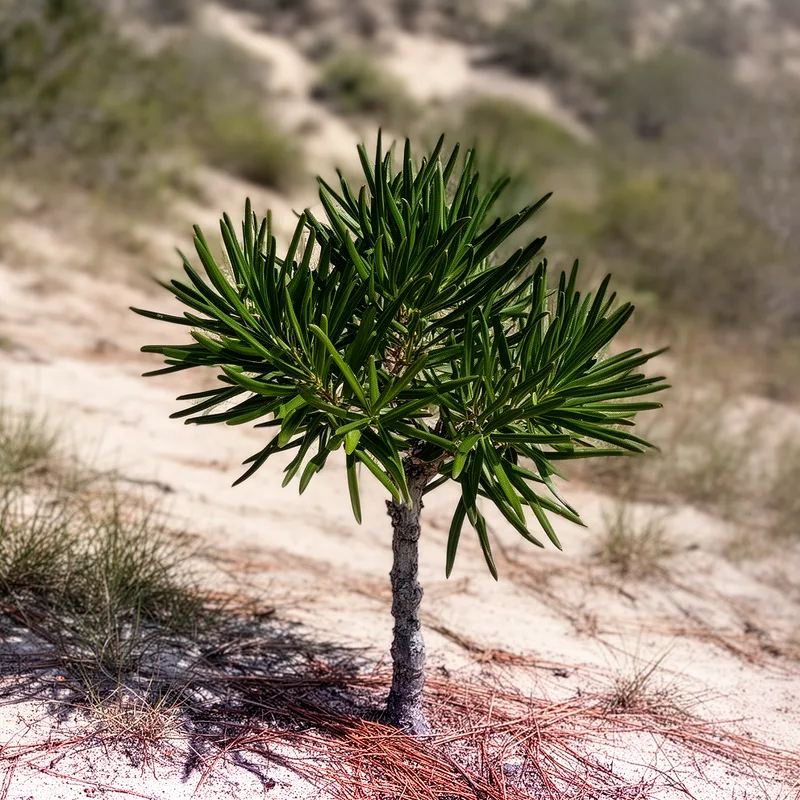
Quercus laevis
- noun
- Specialized
- The leaves of the Quercus laevis have unique bristle-tipped lobes that resemble a turkey's toes.
Examples
-
The leaves of the Quercus laevis are easily recognized by their bristle-tipped lobes.
-
The dry, sandy slopes in the region are home to the Quercus laevis.
-
Botanists often study Quercus laevis for its adaptation to nutrient-poor soils.
-
The Quercus laevis is often found in sandy soils.
-
I saw a Quercus laevis during my hike in Georgia.
-
In the southeastern United States, the Quercus laevis thrives in dry, sandy barrens.
-
During my nature walk, I noticed a beautiful Quercus laevis with its distinct lobed leaves.
Synonyms

A tree from the southeastern United States with thin leaves that have pointy tips and deep lobes

A small slow-growing tree with leaves shaped like a turkey's foot that lives on dry sandy soil
Surface Forms
Morphology
Quercus + laevis
This is a Latin scientific binomial rather than an English compositional phrase, so a B1 learner who knows ordinary English words would not be able to derive the meaning: 'laevis' is Latin (not attested in the learner's dictionary) and 'Quercus' is a taxonomic genus name rather than the everyday word 'oak'. The phrase is specialized taxonomy whose species-level meaning (‘a particular oak species’) is technical and not predictable from common English vocabulary.
Etymology
Quercus laevis is the Latin name for a small tree often called the 'turkey oak'. The part Quercus means 'oak' and laevis is the second part of the name; its leaves have bristle-tipped lobes like a turkey's toes, so the name helps you picture and remember this dry, sandy-soil oak.

