
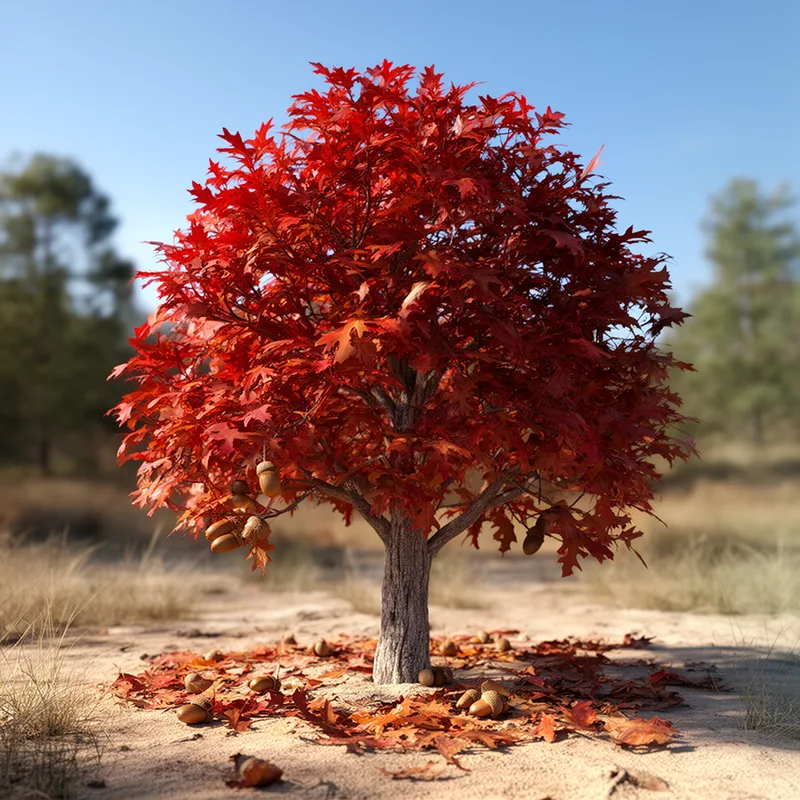
Quercus ellipsoidalis
- noun
- Specialized
- The Quercus ellipsoidalis is known for its distinctive leaves with sharply pointed lobes.
Examples
-
The Quercus ellipsoidalis thrives in sandy soils and is often found in open woodlands.
-
In the fall, the leaves of Quercus ellipsoidalis turn a vivid red, adding color to the landscape.
-
Botanists studied the unique acorn shape of Quercus ellipsoidalis during their field research.
-
The Quercus ellipsoidalis thrives in well-drained soils.
-
Have you seen a Quercus ellipsoidalis in bloom?
-
Many wildlife species depend on the acorns produced by the Quercus ellipsoidalis for food.
-
During autumn, the foliage of Quercus ellipsoidalis transforms into brilliant shades of red and yellow.
Synonyms

A small to medium oak tree from east-central North America with leaves that have many sharp points
How Big


Surface Forms
Morphology
Quercus + ellipsoidalis
This is a Latin binomial made up of the genus name Quercus (oak) and a descriptive epithet ellipsoidalis (derived from 'ellipsoid' = ellipsoid-shaped). If a learner knows both constituents, they can transparently infer it refers to a species of oak characterized by ellipsoid features (e.g., shape of acorns or other parts); binomial naming is compositional and cross-linguistically recognizable in scientific contexts.
Etymology
Quercus ellipsoidalis comes from Latin: Quercus means 'oak' and ellipsoidalis describes something 'egg-shaped' or 'oval'. This name likely points to the tree's long, oval acorns, so the scientific name helps you remember which kind of oak it is.