
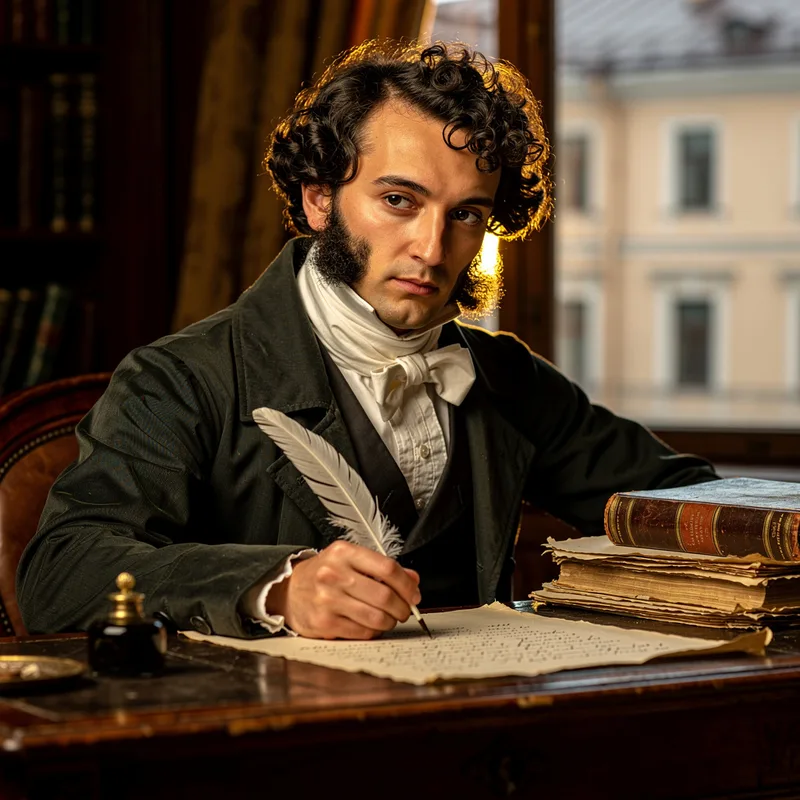
Pushkin
 4
6.1

- proper noun
- /ˈpʊʃkɪn/
- Here's an example from real life: a Russian theater, the Nostalgia, decided to try Pushkin's "Mozart and Salieri:"
- Pushkin the poet
- Pushkin Museum
- works of Pushkin
Examples
-
Alexander Pushkin, regarded as the founder of modern Russian literature, wrote several renowned poems.
-
Many consider Pushkin to be Russia's greatest poet, whose works have influenced generations of writers.
-
Pushkin learned Russian from his nanny; his parents spoke to him solely in French.
Academic text (1998) -
In Borodino, Pushkin wrote his best poetry.
Fiction book (1993) -
The street called Arbat ran past Pushkin's home.
Fiction book (1997) -
Alexander Pushkin, Russia's greatest poet, was shot in a duel and two days later died from his wounds.
-
The headline was a quotation from Russia's Shakespeare, the 19th-century poet Pushkin.
Academic text (2011) -
So begins Alexander Pushkin's sonnet "To a Poet" (which could also be translated "To the Poet").
Blog text (6) -
As the great poet Aleksandr Pushkin once said: "The folktale is not true, but it contains hints, lessons for young people."
Fiction book (1998) -
In her essays, Pomorska considers the works of Pushkin, Tolstoy, Pasternak, Chekhov, and Solzhenitsyn.
Academic text (1993)
Synonyms


 1
5.6
A famous Russian poet, playwright and writer from the 1800s
A Russian poet and writer who started modern Russian literature
Surface Forms
Etymology
Pushkin is a Russian family name that probably comes from old Russian words pushka 'cannon' or pushok 'small fluff'. A helpful way to remember the poet Pushkin is to think of him as a 'small cannon' — small but powerful in Russian literature.