
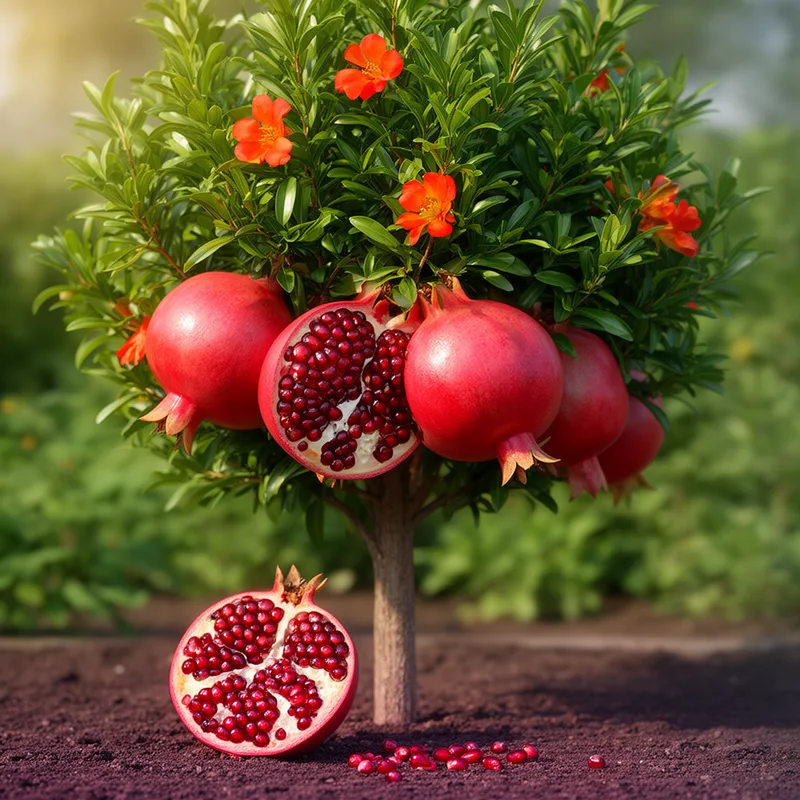
Punica granatum
- noun
- /ˈpjuːnɪkə ɡrəˈnætəm/
- Specialized
- The pomegranate, known scientifically as Punica granatum, is rich in antioxidants and vitamin C.
Examples
-
Many gardens feature Punica granatum for both its ornamental flowers and edible fruit.
-
Botanists classify the pomegranate as Punica granatum in scientific literature.
-
The genus Punica granatum has long been cultivated for its tasty and nutritious seeds.
-
The Punica granatum is often grown in gardens for its beautiful flowers.
-
Did you know that Punica granatum can thrive in dry climates?
-
Many people enjoy the juicy seeds of Punica granatum as a healthy snack.
-
In traditional medicine, Punica granatum has been used for its potential health benefits.
Synonyms
 4
3.5
4
3.5

A small tree or bush that makes round red fruits with many seeds
 1
3.7
1
3.7
A small tree that produces large red fruit with many seeds
Surface Forms
Morphology
Punica + granatum
This is a Latin binomial (scientific) name rather than a compositional English phrase; the constituents are Latin morphemes (one a capitalized genus name, the other not a common English word) so a B1 learner who knows the listed parts would not be able to infer 'pomegranate' without botanical/Latin knowledge. Scientific names are lexicalized and language-specific, making the meaning unpredictable from the surface parts for typical learners.
Etymology
Punica granatum is a scientific name from old Latin words: Punica means 'from Carthage' and granatum means 'many seeds'. So the name points to the pomegranate, the red fruit full of seeds, and helps you remember what the plant is.