
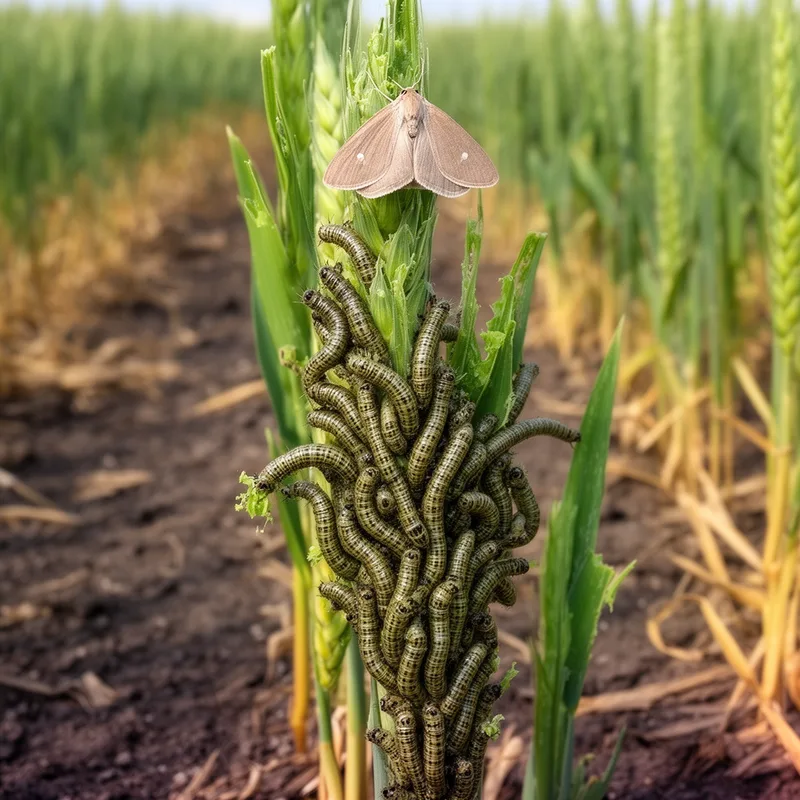
Pseudaletia unipuncta
- noun
- Specialized
 :
Pseudaletia unipuncta
:
Pseudaletia unipuncta
- The larvae of Pseudaletia unipuncta, commonly known as armyworms, can devastate crops in a short time.
Examples
-
Farmers monitor their fields closely during summer for signs of Pseudaletia unipuncta outbreaks.
-
The Pseudaletia unipuncta is a major pest for farmers.
-
Pseudaletia unipuncta infestations have caused severe damage to wheat fields across the region.
-
Many crops were devastated by Pseudaletia unipunctas last year.
-
Farmers often find that Pseudaletia unipuncta can swarm through entire fields, leaving nothing but destruction in their wake.
-
During peak season, the presence of Pseudaletia unipuncta increases, prompting farmers to take action to protect their crops.
-
The larvae of Pseudaletia unipuncta work together in large groups, leading to significant crop loss for agricultural producers.
Surface Forms
Morphology
Pseudaletia + unipuncta
The genus element 'Pseudaletia' explicitly marks this as a moth taxon, so a learner who knows that constituent can infer it names a kind of moth. However, the species epithet 'unipuncta' is not a common English word (and is a Latin label), and details like larval behaviour and pest status cannot be derived from the parts, making the name only partially transparent.
Etymology
Pseudaletia unipuncta probably comes from name parts pseudo meaning 'false' or 'look-alike', aletia meaning a moth group name, and uni + puncta meaning 'one spot'. So the name gives a simple picture: a moth that looks like another kind but has one small spot, and that small mark helps explain why it was named this way.

