
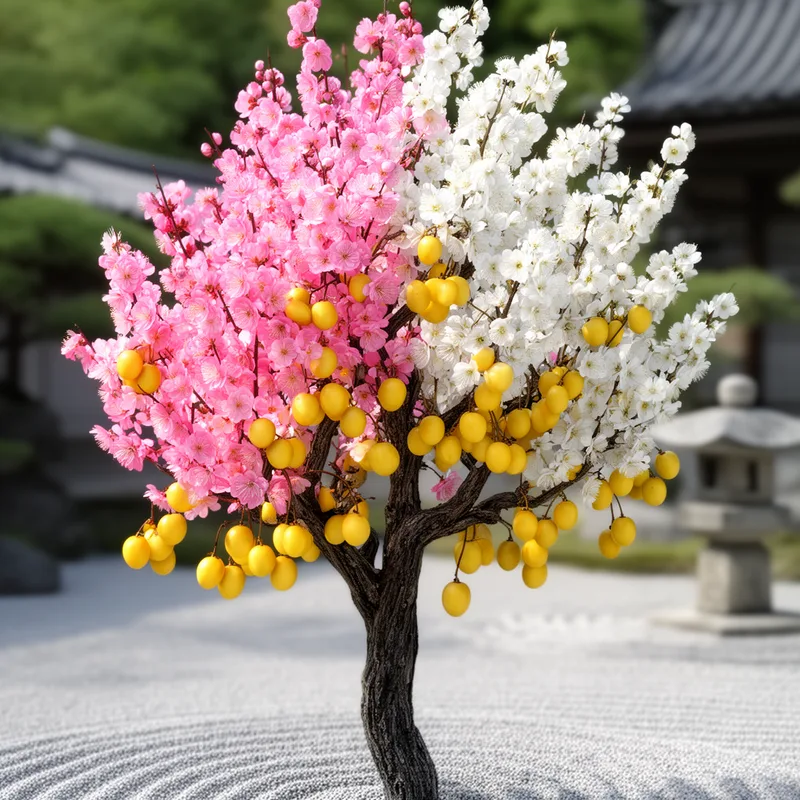
Prunus mume
- noun
- Specialized
- The Prunus mume trees bloom early in spring, adding delicate pink and white flowers to the garden.
Examples
-
The fruit of the Prunus mume is commonly used to make umeboshi, a type of pickled plum.
-
Traditional Japanese art often features the blossoms of Prunus mume as a symbol of perseverance and renewal.
-
The Prunus mume tree blooms beautifully in early spring.
-
Many gardeners love the Prunus mume for its fragrant flowers.
-
The Prunus mume trees bloom early in spring, adding delicate pink and white flowers to the garden.
-
The fruit of the Prunus mume is commonly used to make umeboshi, a type of pickled plum.
-
Many gardeners love the Prunus mume for its fragrant flowers.
Synonyms
 11
9.9
11
9.9

A small Japanese tree with white or pink flowers and small yellow fruit often grown in gardens

A tree with fragrant white or pink blossoms and small yellow fruit
A Japanese plum tree with pale pink or white flowers that bloom in late winter
Surface Forms
Morphology
Prunus + mume
The form is a Latin binomial where 'Prunus' clearly signals a genus of fruit trees, so a learner who knows that could infer this is a type of tree or fruit. However, the specific epithet 'mume' is not an English lexical item (and is culturally/language-specific), and binomial names do not follow ordinary compositional English patterns, so the precise common meaning ('Japanese apricot/ume' with fragrant blossoms and small fruits) is not fully derivable.
Etymology
Prunus mume comes from the Latin word Prunus meaning 'plum' and the Japanese name mume, written 'ume', for the same tree. So the name is like 'plum' plus 'ume' and helps you remember this East Asian tree often called the 'Japanese apricot' with fragrant blossoms and small plum-like fruit.