
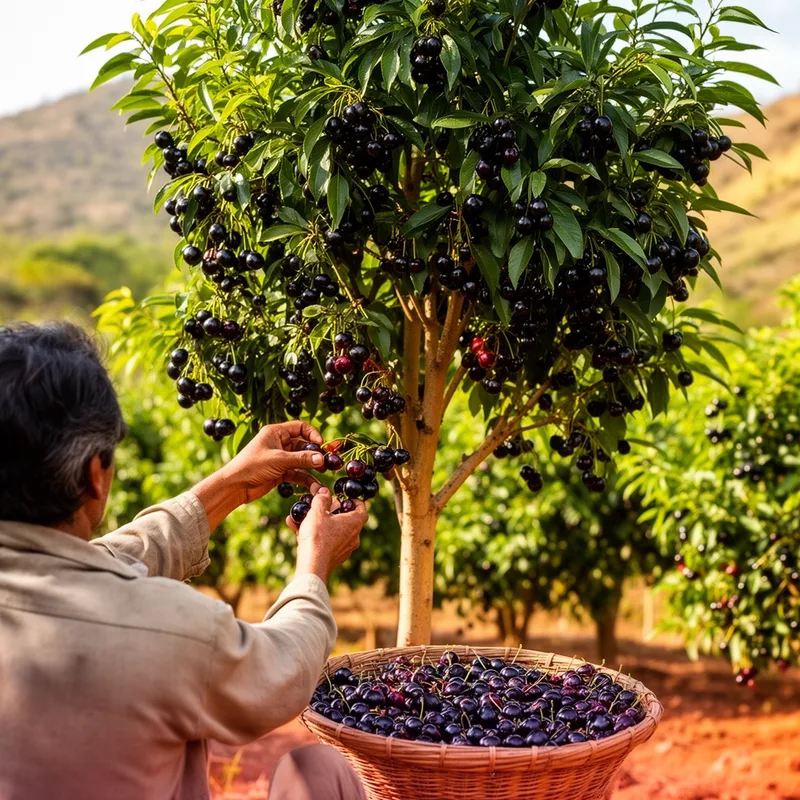
Prunus capuli
- noun
- Specialized
- The fruits of the Prunus capuli are enjoyed in traditional Latin American desserts.
Examples
-
Farmers in Mexico often cultivate Prunus capuli for its sweet, dark berries.
-
The Prunus capuli tree produces sweet cherries.
-
The wood from Prunus capuli trees is also valued for making furniture.
-
Have you ever tasted Prunus capuli fruit?
-
Farmers in Mexico often cultivate Prunus capuli for its sweet, dark berries.
-
The fruits of the Prunus capuli are enjoyed in traditional Latin American desserts.
-
The Prunus capuli tree is known for its delicious cherries that are commonly used in jams.
Synonyms
A small dark fruit like a cherry from Mexico and Central America, or the tree that grows it
A Mexican tree that grows small dark cherries you can eat

A tree from Mexico that makes dark purple, almost black cherries
Surface Forms
Morphology
Prunus + capuli
The phrase is a Latin binomial (genus + species): 'Prunus' denotes a genus of fruit-bearing trees, and 'capuli' functions as a species epithet/proper name even though it is not a standard English dictionary word. A learner who knows that 'Prunus' refers to a group of fruit trees and recognises 'capuli' as a specific name can transparently infer this is a particular kind of Prunus (i.e., a type of cherry tree); taxonomic naming is a cross-linguistic, compositional pattern.
Etymology
Prunus capuli is a scientific name that mixes Latin and a local word: Prunus means 'plum' or 'cherry' in Latin, and capuli may come from the Spanish and Nahuatl word 'capulín' for a small dark cherry. So the name shows that this tree is a cherry-like plant with edible dark fruit.

