
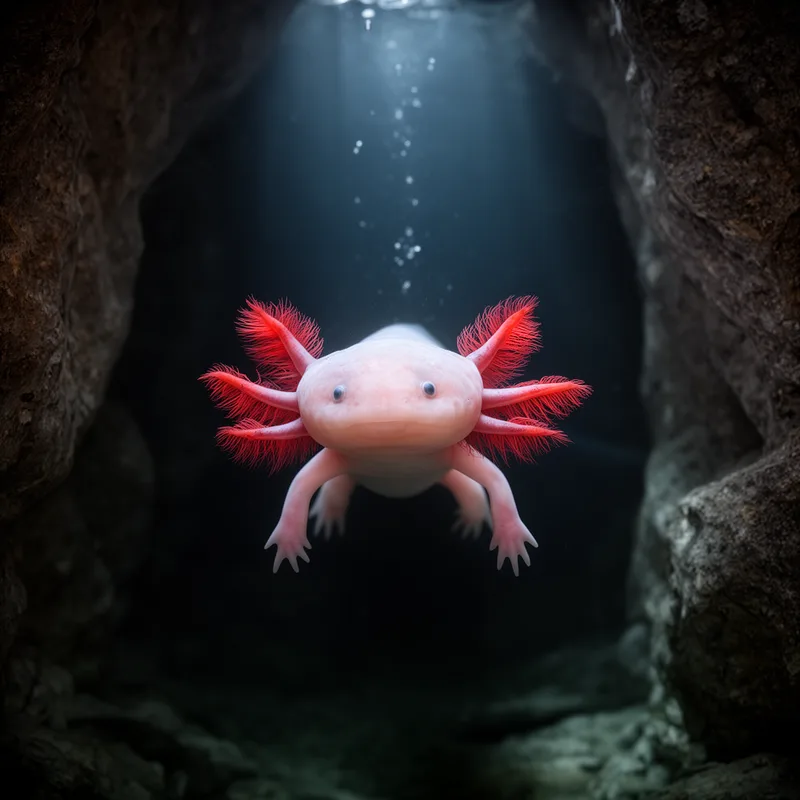
Proteus anguinus
- noun
- Specialized
- Unlike most salamanders, Proteus anguinus retains its gills throughout its life.
Examples
-
The Proteus anguinus is uniquely adapted to life in the pitch-black caves of the Balkans.
-
Scientists study Proteus anguinus to learn about evolution in isolated environments.
-
The Proteus anguinus is often found in the caves of Slovenia.
-
Did you know that the Proteus anguinus can live for over 100 years?
-
The Proteus anguinus is a fascinating creature known for its ability to thrive in total darkness.
-
Scientists have discovered that the Proteus anguinus can survive in caves for many decades.
-
With its permanent external gills, the Proteus anguinus is well adapted to its underground aquatic habitat.
Synonyms


 1
9.9
1
9.9
A blind salamander that lives underwater in caves and keeps its gills
Surface Forms
Morphology
Proteus + anguinus
This is a scientific Latin binomial functioning as a proper name for a species (the olm). Even if a learner knows 'Proteus' as a genus, the detailed biological meaning (aquatic cave salamander with permanent external gills adapted to darkness) is not derivable from the parts, and 'anguinus' is not an English lexical item. As a language learning item it behaves like an arbitrary label rather than a compositional phrase, so it is opaque to B1 learners.
Etymology
Proteus anguinus may get its name from the old sea-god Proteus, who could 'change shape', because the animal looks strange and different from other salamanders. The second part, anguinus, comes from a word for 'snake' and points to its long, thin body, so the name fits this pale, cave-living salamander.