
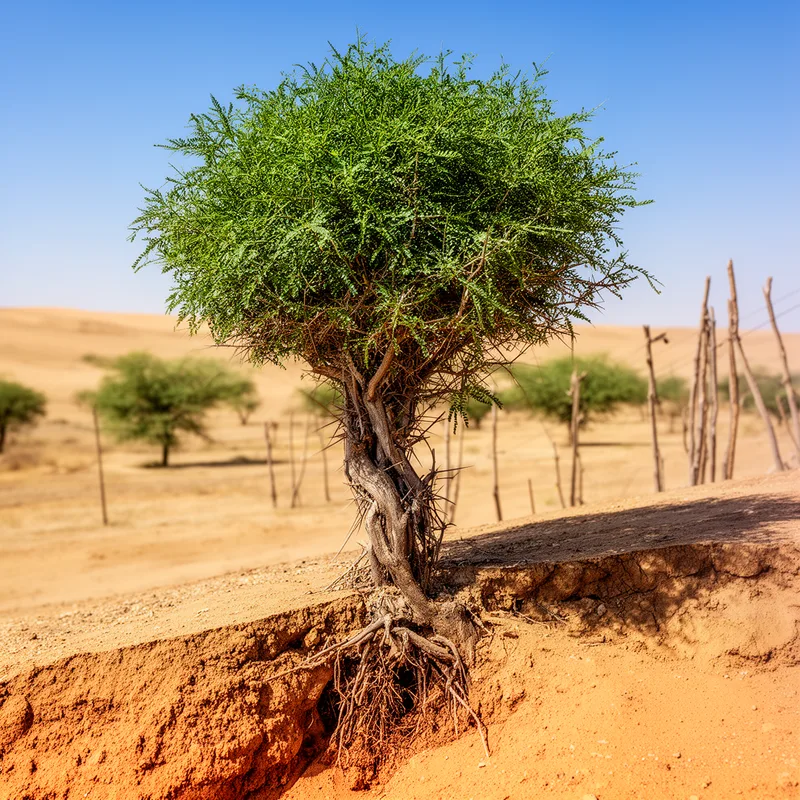
Prosopis juliflora
- noun
- Specialized
- Local farmers use wood from Prosopis juliflora for fuel and fencing.
Examples
-
Many farmers plant Prosopis juliflora for erosion control.
-
The spread of Prosopis juliflora has significantly altered the landscape in some African countries.
-
Prosopis juliflora is often planted in arid regions to combat desertification.
-
The Prosopis juliflora thrives in arid conditions.
-
Prosopis juliflora is a popular choice among landscapers for erosion control in dry areas.
-
Due to its drought resistance, Prosopis juliflora is frequently used in reforestation projects.
-
Prosopis juliflora provides a valuable habitat for various wildlife in arid environments.
Synonyms

A hardy thorny tree that spreads quickly and takes over land
Surface Forms
Morphology
Prosopis + juliflora
The form follows a transparent binomial pattern (genus + species): knowing 'Prosopis' as a plant genus lets a learner infer this is a particular species of Prosopis and that it is a plant associated with arid climates. However, 'juliflora' is a Latin species epithet (not lexically transparent to a B1 learner) and the specific traits (drought resistance, use in erosion control) are not derivable from the parts without specialist knowledge, so the meaning is only partially predictable.
Etymology
Prosopis juliflora comes from two parts: the group name Prosopis (the mesquite group) and the second part juliflora. One common idea is that juliflora means 'July flowers' because the tree makes long clusters of flowers in the hot season, so the name helps you remember a hardy, drought-resistant mesquite that blooms in summer.

