
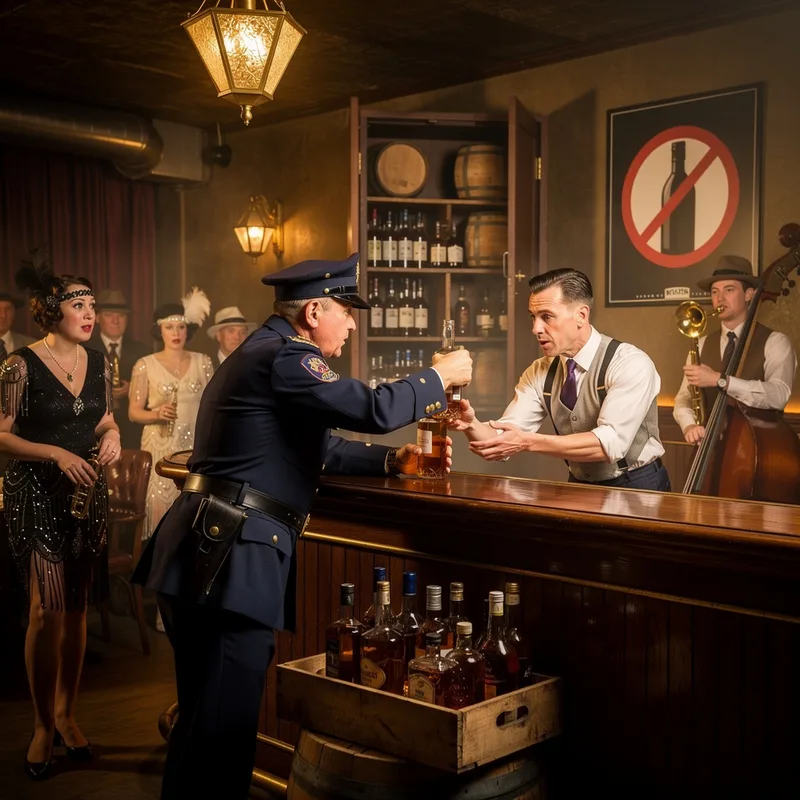
Prohibition era
 3
7.4
3
7.4

- noun
- /ˌproʊɪˈbɪʃən ˈɪərə/
- US
- The Prohibition era, from 1920 to 1933, drastically changed American society regarding alcohol consumption.
- Prohibition-era speakeasy
- Prohibition-era gangsters
- Prohibition-era law
Examples
-
The Prohibition era was over.
-
Maybe this will develop into a Prohibition-era type issue, where retailers take the role that speakeasies did.
Blog text (30) -
The National Firearms Act of 1934 was enacted as part of President Roosevelt's effort to combat Prohibition-era violence.
Academic text (2016) -
Nucky covertly encouraged the sale and consumption of various illegal products and services in Prohibition-era Atlantic City.
Blog text (13) -
Hammett employed the gangster slang of America's Prohibition-era mean streets to create a vivid sense of time and place through his language.
Academic text (1997) -
Miller's Crossing takes place in an unnamed Prohibition-era town ruled by a political machine that offers unofficial liquor and gaming licenses.
Academic text (2001) -
Slathered in wine-colored travertine, the rotunda has the ambience of a Prohibition-era Chicago nightclub.
Academic text (2005) -
During the Prohibition era, many people turned to illegal speakeasies to drink alcohol.
-
Movies often depict the Prohibition era as a time of gangster violence and underground bars.
Synonyms
 14
5.5
14
5.5
A period, especially in the United States from 1920 to 1933, when making, selling, and moving alcoholic drinks was illegal
 12
4.9
12
4.9
A period in the United States from 1920 to 1933 when making, selling, and moving alcohol was illegal
Surface Forms
Morphology
The meaning is directly derived from combining 'prohibition' (a ban, here specifically the ban on alcohol) with 'era' (a time period), so it names the time when prohibition occurred. This noun+noun pattern for naming historical periods is common across languages, so a B1 learner who knows both constituent words would readily infer the intended meaning.
Etymology
Prohibition era comes from the word prohibition meaning 'to ban' and era meaning 'a time'. In the United States it refers to 1920 to 1933, when a law made alcohol illegal and people drank in secret bars called speakeasies, so the phrase means 'the time when alcohol was banned'.