

Progressive Party
 3
6.5
3
6.5

- proper noun
- /prəˈɡrɛsɪv ˈpɑrti/
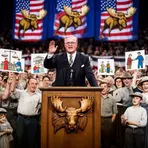
- In 1912, the Progressive Party emerged as a powerful force in American politics, challenging the traditional parties.
Examples
-
The Progressive Party, founded by Theodore Roosevelt in 1912, aimed to address issues like workers' rights.
-
Like Young, she had been a leader of the Progressive Party in the early Cold War years.
Academic text (1997) -
Up until now, I had respect for the Progressive Party.
Blog text (24) -
In 1948, Young was state director of the Progressive Party of Michigan and ran for state senate on the party's ticket.
Academic text (1997) -
What brought the Robber Barons down in the Gilded Age was the emergence of the Progressive Party.
Blog text (4) -
Despite these contributions, Croly's most important influence on the Progressive Party remained his catalysis of Roosevelt's thinking in the years before its founding.
Academic text (2013) -
In 1912, Taft found himself the incumbent while Roosevelt, the nominee of the Progressive Party, was now a challenger.
Academic text (1997) -
During the election, many voters supported the Progressive Party, hoping for significant political reform.
Synonyms

 1
8.9
1
8.9
A former US political party started by Theodore Roosevelt in 1912 that supported progressive reforms
Surface Forms
Morphology
The headword is transparently built from 'progressive' (supporting reform) + 'party' (a political group), so a B1 learner who knows both constituents can infer it refers to a political party advocating reform. Specific historical facts (that it was Roosevelt's 1912 party, the 'Bull Moose' Party) are encyclopedic and not derivable from the words, but they do not make the core meaning opaque.
Etymology
Progressive Party takes its name from the group's aim for social and political 'progress' — a progressive party that wanted change. In 1912 Theodore Roosevelt started the party and used the bull moose as a symbol after he said he felt 'fit as a bull moose', so the name came to mean a strong group pushing for reform.