
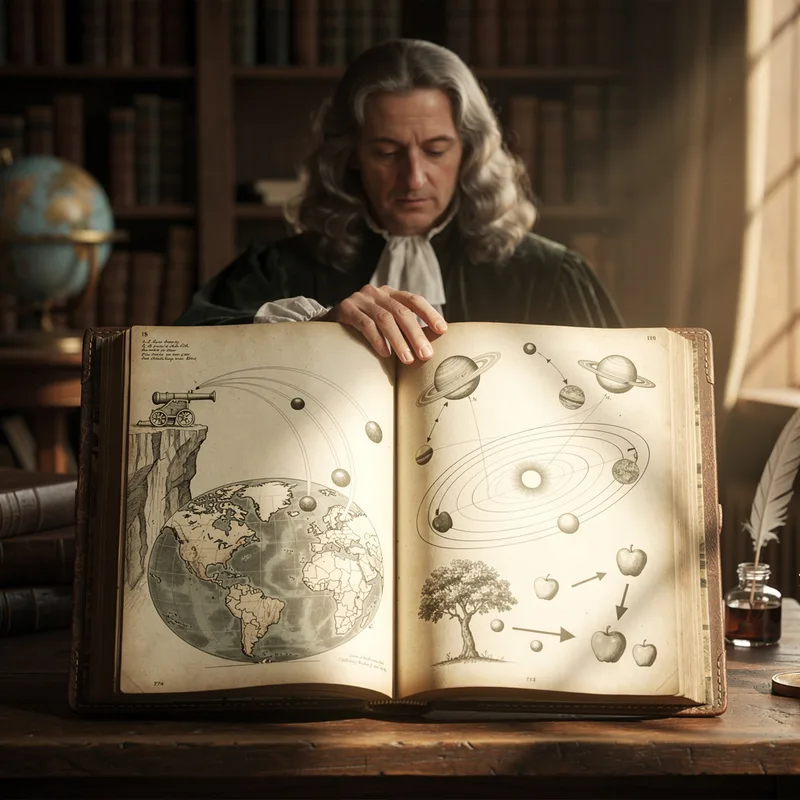
Principia
 2
9.6

- proper noun
- /prɪnˈsɪpiə/
- Formal
- I doubt that either Broad or Wade read Newton's Principia either in the original Latin or in English translation.
- Principia, Newton
- Principia Mathematica
- Principia in 1687
Loading YouTube…
Watch on YouTubeIf you read, if you read Newton's, Newton's Principia, where he talks about the calculus, he's not talking about numbers, he's talking about quantities calculus.
- If you read, if you read Newton's, Newton's Principia, where he talks about the calculus, he's not talking about numbers, he's talking about quantities calculus.
Examples
-
Newton added another dimension to the thought with his "Principia," which defined and explained further the natural world.
Blog text (16) -
Why is Opticks so different from the Principia?
Academic text (1998) -
This is the Principia, not a copy of the Principia.
-
With this discussion of God, the reader has arrived at the end of the Principia.
Academic text (2009) -
And that's why the Principia is so hard to read.
-
Though his Principia, published in 1687, surely introduced a scientific revolution, no one has ever called it a page-turner.
Academic text (1998) -
And you are going to quote the proposition and lemma by number from Newton's PRINCIPIA in support of this?
Blog text (25) -
Editor of the third edition of the Principia (1726), Pemberton combined Newtonian science with Shaftesburian aesthetics.
Academic text (2016) -
I learned physics through Newton's Principia, and geometry through Euclid and Lobachevski—in a college program with no electives.
Academic text (2005) -
Isaac Newton's Principia laid the groundwork for classical mechanics.
Surface Forms
Etymology
The word Principia comes from the Latin principium, meaning 'principles' or 'beginnings', and it is the same root as the English word principle. Newton used Principia in his title to show the book gives the basic rules of nature, so the name fits its meaning as his main work on motion and gravity.