

Precambrian period
- noun
- /priˈkeɪmbriən ˈpɪərɪəd/
- Specialized
 :
período precámbrico
:
período precámbrico
- Scientists study the geology of the Precambrian period to understand the planet's formation.
Examples
-
The fossils found in rocks from the Precambrian period provide crucial insights into early life on Earth.
-
Sexuality is itself an "adaptation" to these conditions, and while biological life existed in abundance in the Precambrian period for a billion+ years, sexuality does not appear until approximately 650 million years.
Blog text (3) -
The Precambrian period spans a vast time, covering events before the emergence of complex life.
Synonyms
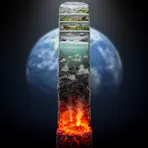
A long period in Earth's history from about 3,800 million to 544 million years ago

A very long part of Earth's history from about 3.8 billion to 544 million years ago
Surface Forms
Morphology
The phrase is compositionally built from a named geologic era 'Precambrian' plus the noun 'period' meaning a measured interval, so it simply denotes the time interval called the Precambrian. This proper-name + temporal-noun pattern is transparent and cross-linguistically common, so a B1 learner who knows both constituents would be able to infer the meaning.
Etymology
Precambrian period gets its name from the parts pre (meaning 'before') and Cambrian, which comes from Cambria, an old name for 'Wales' where scientists first studied rocks full of fossils. So the Precambrian period means the very long time 'before' the Cambrian, when Earth had mostly simple life and few large fossils.

