
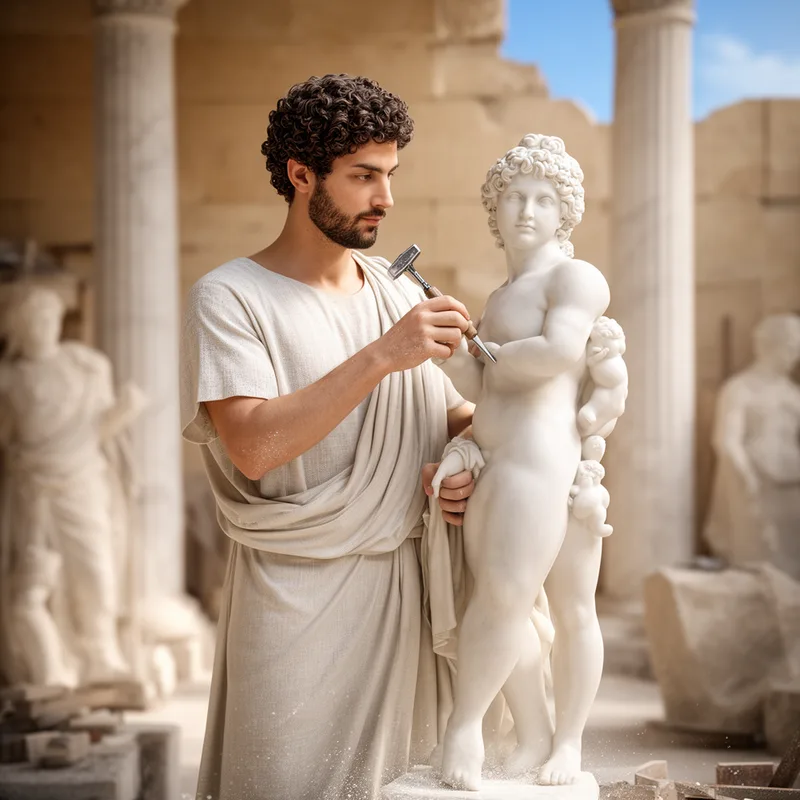
Praxiteles


 1
9.9
- proper noun
- And which strives for the enjoyment of beauty—whether its creator be Praxiteles, Raphael, or Cezanne—with the exception of radical modern contrivances.
Examples
-
Modeled on the male statues of Classical masters such as Polycletus (fifth century B.C.) and Praxiteles (fourth century B.C.), the standard Alexander pose is generally associated with Lysippus, a contemporary of the Macedonian king.
Academic text (2005) -
But if the astronomer looked like an Olympian, tall, strong, and beautiful, with the shoulders of the Hermes of Praxiteles, and the benign serenity, it became unusual.
Academic text (1990) -
There are four known sets, after the Praxiteles originals.
-
Most likely sculpted under the influence of Praxiteles.
-
Their execution might be of a superior order, the work of a Phidias or a Praxiteles, but their psychology was rudimentary.
Fiction book (2002) -
Bennett attributed the work to Praxiteles, one of the greatest sculptors of ancient Greece.
-
Most likely sculpted under the influence of Praxiteles, this statue exhibits remarkable grace.
-
Standing almost eight feet tall, the piece recalls the legendary Aphrodite of Praxiteles.
Surface Forms
Etymology
Praxiteles is the name of a famous ancient Greek sculptor and comes from Greek parts praxi- meaning 'action' and -teles meaning 'complete'. So you can remember Praxiteles as 'one who finishes by doing', which fits a sculptor who brings stone to life.