

Pliny the Elder
 2
7.9

- proper noun
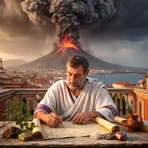
- The death of Pliny the Elder during the eruption of Vesuvius is well-documented by his nephew.
Examples
-
Pliny the Elder wrote extensively on topics ranging from natural history to mineralogy.
-
Historians often reference Pliny the Elder for insights into life in Ancient Rome.
-
Pliny the Elder was a great thinker.
-
Pliny the Elder wrote extensively.
-
Pliny the Elder is often regarded as one of the first naturalists for his work in the field of natural history.
-
Many students of history study Pliny the Elder to understand the scientific knowledge of the Roman Empire.
-
The writings of Pliny the Elder on plants and animals laid the foundation for future naturalists.
Synonyms

 1
9.9
A Roman writer who studied nature and died in the Vesuvius eruption
Surface Forms
Morphology
The phrase is compositionally interpretable as referring to an older person named Pliny — 'the Elder' signals a comparative/epithet distinguishing him from a younger namesake — so learners who know the words will infer it names an older Pliny. However, the specific encyclopedic identity (a Roman author/naturalist who died at Vesuvius) is world knowledge not recoverable from the constituents alone. Because the grammatical/epithetic meaning is transparent but the historical referent is not, it is intermediate in transparency.
Etymology
Pliny the Elder was a Roman writer who made a very large book called 'Natural History' describing plants, animals and minerals. He is also remembered for going to watch the eruption of Mount Vesuvius and dying while observing it, and the name 'Elder' marks him as the older Pliny, so people remember him both for his book and for dying as a careful observer.