

Plectranthus amboinicus
- noun
- Specialized
- Many households grow Plectranthus amboinicus for its fragrant leaves, which are used in traditional remedies.
Examples
-
The chef added fresh Plectranthus amboinicus to the soup for a unique flavor.
-
Plectranthus amboinicus thrives in warm climates and is often grown on windowsills.
-
I love using Plectranthus amboinicus in my cooking.
-
Have you ever tried Plectranthus amboinicus in your dishes?
-
Many households grow Plectranthus amboinicus for its fragrant leaves, which are used in traditional remedies.
-
The chef added fresh Plectranthus amboinicus to the soup for a unique flavor.
-
Plectranthus amboinicus thrives in warm climates and is often grown on windowsills.
Synonyms

A small plant with thick, strong-smelling leaves used in cooking and medicine

A plant with soft leaves and a strong smell used in cooking and medicine
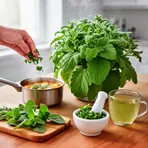
A fragrant herb with thick leaves used in cooking and medicine
Surface Forms
Morphology
Plectranthus + amboinicus
This is a scientific Latin binomial: knowing 'Plectranthus' only signals a plant genus and 'amboinicus' is not a standard English word (and is not listed), so the detailed meaning (an aromatic perennial used in cooking and medicine, native to specific regions) cannot be derived from the parts. Scientific names are proper nouns and not compositionally informative for learners, so a B1 learner who 'knows' the constituents would still not infer the full MWE meaning.
Etymology
Plectranthus amboinicus has thick, fuzzy leaves that give off a strong oregano-like smell, so people kept it near the stove and used it to flavor food and soothe coughs. That's why the name now means a small, fragrant herb used for 'cooking' and 'home medicine'.

