
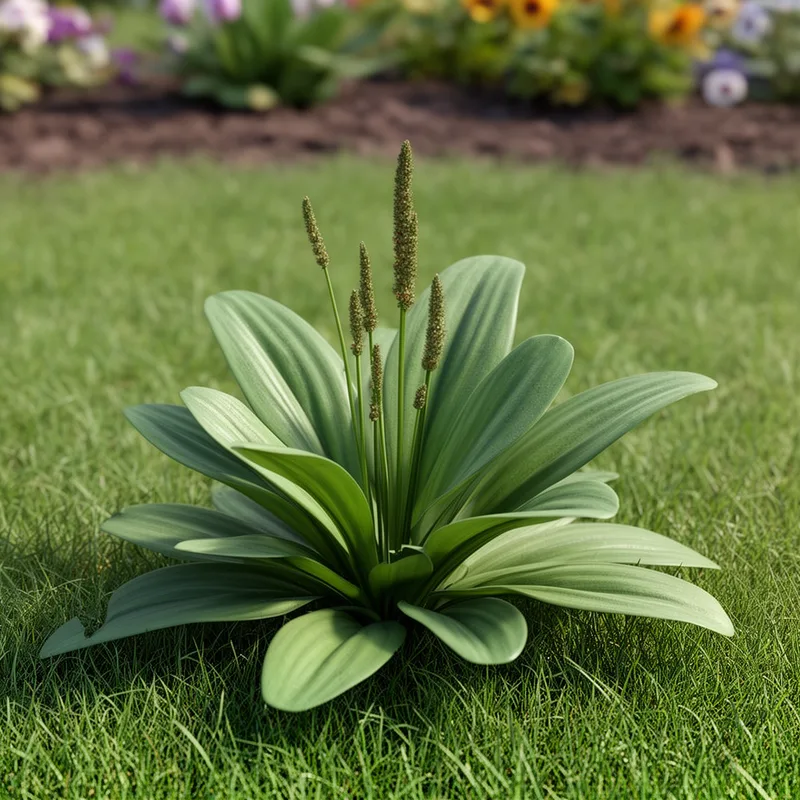
Plantago major
- noun
- /plænˈteɪɡoʊ ˈmeɪdʒər/
- Specialized
- Plantago major can quickly invade lawns and gardens if not controlled.
Examples
-
The leaves of Plantago major are sometimes used in herbal remedies for minor wounds.
-
Many gardeners consider Plantago major a troublesome weed.
-
Many people mistake Plantago major for an unremarkable weed, but it is highly adaptable.
-
The Plantago major is often found in gardens.
-
Many gardeners consider Plantago major a troublesome weed in their flower beds.
-
In urban areas, Plantago major often spreads quickly through cracks in the pavement.
-
You can find Plantago major thriving in grassy patches and meadows across Europe.
Synonyms

A common weed with wide leaves that grows in lawns and bare ground

A common weed with broad, round leaves that grows in lawns and roadsides

A low plant with broad leaves that grows as a weed in lawns and fields

A common weed with wide leaves that grows in lawns and gardens
Surface Forms
Morphology
This is a taxonomic Latin binomial: if a learner knows 'Plantago' as a plant genus and 'major' as 'larger/greater', they can infer it names a species of Plantago and that it is the 'larger' or more prominent form. However, the precise common name, ecological connotations (e.g. 'broadleaf plantain', 'weed', 'perennial') and everyday meaning are not fully predictable from the parts alone, so comprehension is only partial.
Etymology
Plantago major gets its name from old Latin: plantago comes from 'planta' meaning 'the sole of the foot', because the plant's broad, flat leaves lie close to the ground, and major means 'larger'. So the name gives a simple picture — a big, flat-leaf plant — which fits this common broadleaf weed.

