
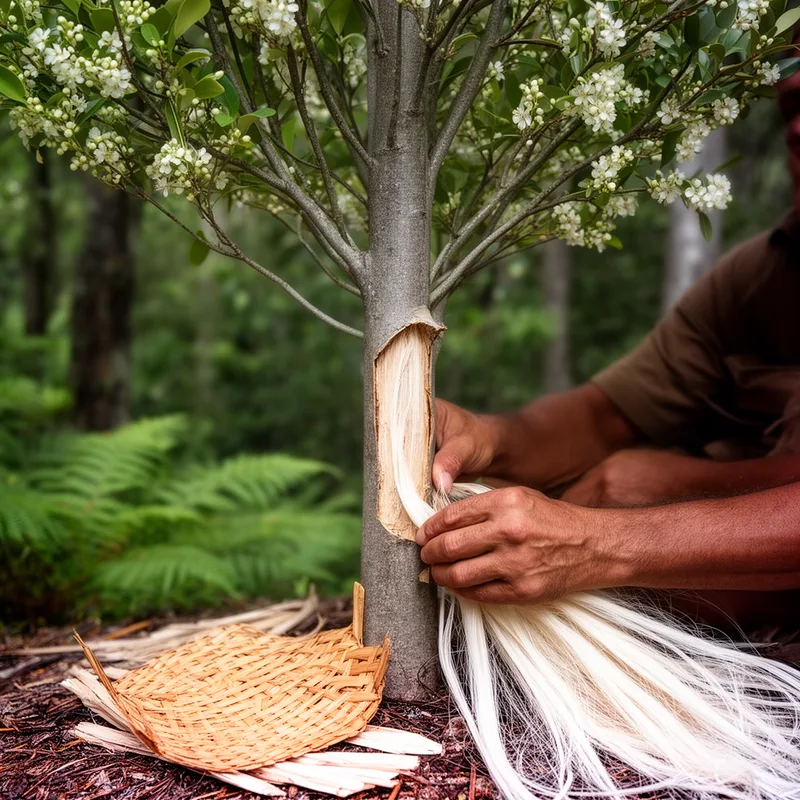
Plagianthus regius
- noun
- Specialized
- The inner bark of the Plagianthus regius is harvested to produce a fibre similar to flax.
Examples
-
Māori traditionally used Plagianthus regius to weave strong fabrics from its bark.
-
In New Zealand, the Plagianthus regius tree is prized for its high-quality fibre, often referred to as New Zealand cotton.
-
Many New Zealand gardens feature the striking Plagianthus regius for its showy white flowers.
-
The Plagianthus regius is known for its strong fibre.
-
Have you ever seen a Plagianthus regius tree?
-
The inner bark of the Plagianthus regius yields a durable fibre that can be used for making clothing.
-
Māori artisans historically utilized Plagianthus regius to create robust woven materials from its inner bark.
Synonyms
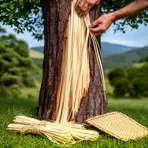
A New Zealand tree whose inner bark makes a strong fiber like flax

A tree from New Zealand that loses its leaves and has inner bark with strong fiber like flax

A New Zealand tree with strong bark that people use to make cord and that has small white fragrant flowers
Surface Forms
Morphology
The form is a Latin binomial: combining the genus 'Plagianthus' with the epithet 'regius' transparently signals a species name (and 'regius' evokes 'royal'), so a learner who knows both constituents can infer it names a particular Plagianthus. However, the detailed encyclopedic attributes in the gloss (deciduous, New Zealand native, inner bark yielding strong fibre) are not derivable from the parts, so the composition is only partially transparent.
Etymology
Plagianthus regius may come from old Greek and Latin words. The first part, Plagianthus, likely means 'slanted flower' because its white flowers often hang to one side, and regius means 'royal', so the name gives the image of a proud, showy New Zealand tree whose strong inner bark was used for weaving.

