
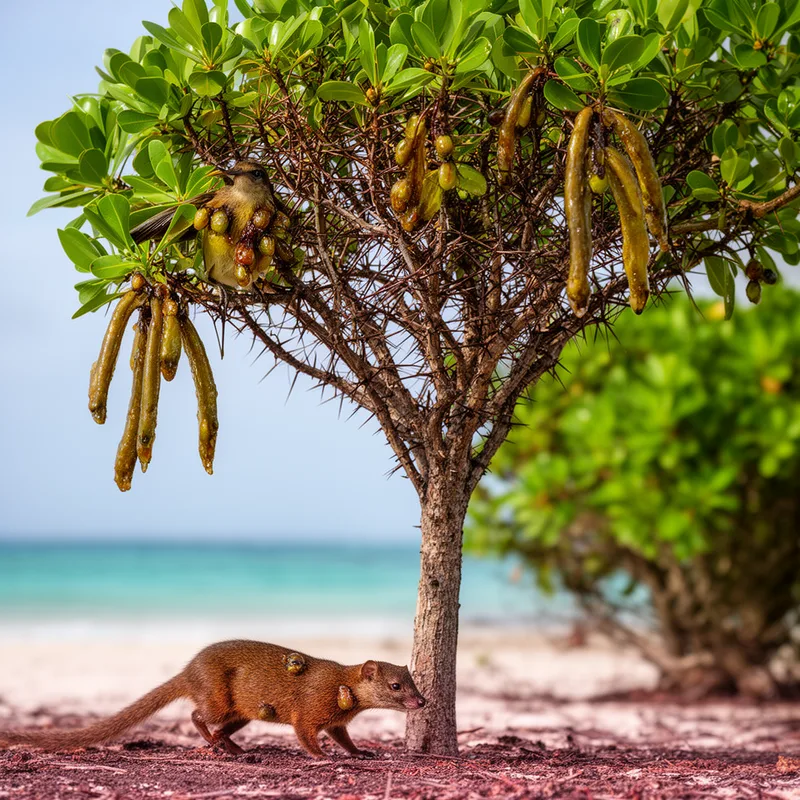
Pisonia aculeata


 1
9.9
- noun
- Specialized
- The Pisonia aculeata produces sticky fruits that often attach to birds, aiding in seed dispersal.
Examples
-
The Pisonia aculeata produces sticky fruits that often attach to animal fur and feathers.
-
Several islands in the Caribbean feature dense thickets of Pisonia aculeata.
-
Botanists studying tropical flora frequently encounter the spiny Pisonia aculeata tree.
-
The Pisonia aculeata tree is often found in coastal areas.
-
Many birds nest in the Pisonia aculeata trees.
-
In the West Indies, the small spiny Pisonia aculeata tree is recognized for its unique reproductive strategy.
-
Researchers noted how the Pisonia aculeata thrives in tropical climates and supports various wildlife.
Surface Forms
Morphology
Pisonia + aculeata
This is a scientific Latin binomial (a species name) functioning as a label rather than a compositional English phrase. Even though 'Pisonia' denotes a genus of tropical trees, the epithet 'aculeata' is a Latin form not likely known to a B1 learner, so the overall meaning ('a small spiny tree with sticky fruits') is not derivable from the constituents by an average learner.
Etymology
Pisonia aculeata comes from how the tree looks: aculeata means 'spiny', and the plant has small sharp points and very sticky fruits. Imagine seeds that 'cling' to a bird's feathers like glue, and you see why the name fits a spiny tree whose sticky fruit travels on animals.