
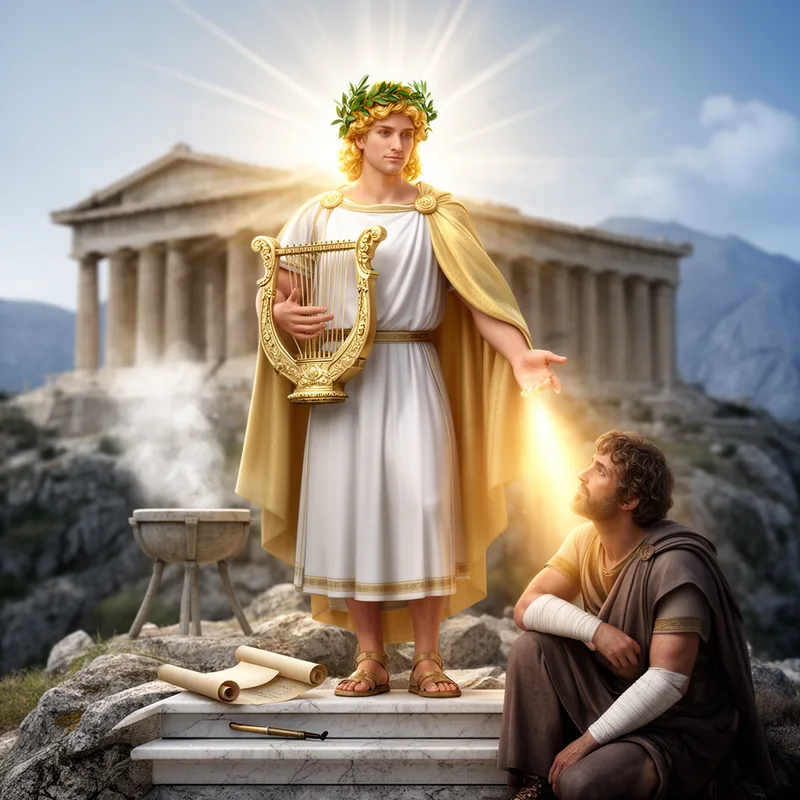
Phoebus Apollo
- proper noun
- Literature
- The temple to Phoebus Apollo at Delphi was a center of prophecy in the Greek world.
Examples
-
In ancient texts, Phoebus Apollo is often invoked as the patron of poets and musicians.
-
Artists frequently depicted Phoebus Apollo crowned with laurel and bearing a lyre.
-
In ancient Greece, Phoebus Apollo was revered as the god of light.
-
Many poets have written about Phoebus Apollo and his gifts.
-
Artists frequently depicted Phoebus Apollo crowned with laurel and bearing a lyre.
-
In ancient texts, Phoebus Apollo is often invoked as the patron of poets and musicians.
-
The temple to Phoebus Apollo at Delphi was a center of prophecy in the Greek world.
Synonyms
 239
4.7
239
4.7

A god in Greek myths of light, music, poetry, prophecy, and healing
 3
9.9
3
9.9
A name for the Greek god Apollo, who is the god of the sun, music and healing
Surface Forms
Morphology
This is a tautological proper name: 'Phoebus' is an epithet/name for Apollo and 'Apollo' is the Greek deity, so a B1 learner who knows both constituents will understand it refers to the god. The combination follows straightforward naming/epithet conventions rather than an idiomatic shift, making the meaning directly derivable from the parts.
Etymology
Phoebus Apollo comes from the ancient Greek name Phoebus, meaning 'bright' or 'shining', so people imagined him as a god who brings light, plays the lyre, and tells the future. So, when writers use Phoebus Apollo, they mean the god of 'light', 'music', and 'prophecy'.