
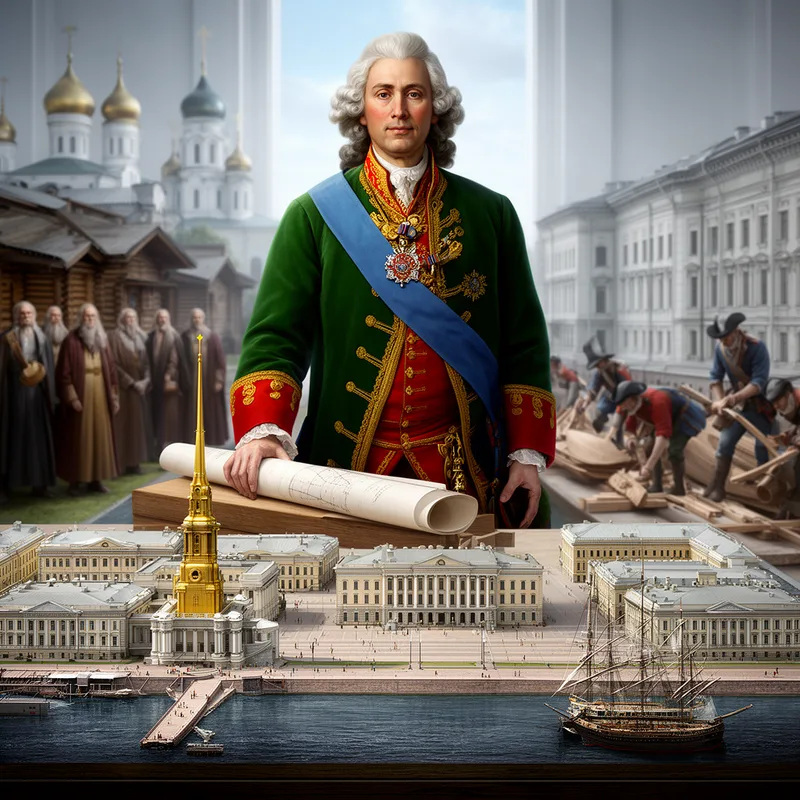
Peter the Great
 3
6.0

- proper noun
- /ˈpiːtər ðə ɡreɪt/
- Though sometimes associated with the Byzantine era, it was Peter the Great who effectively turned the Orthodox Church into a department of state, abolishing the Patriarchate and placing a state-appointed bureaucrat at the head of the church.
- Peter the Great, czar of Russia
Examples
-
By the reign of Peter the Great, financial incentives for conversion, including tax breaks and outright payments, had become standard practice throughout the Muscovite Empire.
Academic text (2007) -
In 1718, by the order of Peter the Great, a special Department of State Religion was created.
Academic text (1996) -
He wanted, like Peter the Great, to have a country that was European.
Academic text (2007) -
The trick of the changing tapestries at Gobelins was meant to dazzle Peter the Great.
Academic text (1996) -
For example, Peter the Great was apparently so moved by one of Ruysch's embalmed infant corpses, displayed in a tiny coffin, that he is said to have kissed it.
Academic text (1996) -
In addition to the fortune bestowed on him by Peter the Great (Ruysch lamented to a friend that he had not asked for even more) and the fees from his regular duties, he made a steady, substantial income from conducting private lessons.
Academic text (1996) -
Surviving Ruysch preparations in jars remain in the University Anatomical Museum in Leiden and Peter the Great's Kunstkammer in St. Petersburg.
Academic text (1996) -
Probably no other nation in history has been shaken to the degree and depth that Russia has by events such as the Tatar-Mongol occupation, the reforms of Peter the Great, seventy years of communism, perestroika, and post-perestroika.
Academic text (1996) -
Peter the Great modernized Russia and founded the city of Saint Petersburg.
-
The reign of Peter the Great was marked by significant territorial expansion for Russia.
Synonyms

 1
7.0
Russian ruler who modernized the country, expanded its land, and founded St Petersburg
 1
7.9
A ruler of Russia from 1682 to 1725 who made the army and government more modern and founded St Petersburg
Surface Forms
Morphology
Peter + the + great
The phrase is a name composed of a personal name plus the descriptive epithet 'the Great', so a B1 learner who knows 'Peter', 'the' and 'great' can infer it refers to a distinguished/historically important person named Peter. Specific historical details (dates, role as Czar) require background knowledge, but the basic referential meaning is transparently built from the constituents and mirrors equivalent constructions in other languages.
Etymology
Peter the Great is a name given to the Russian ruler Peter I because people praised him for big changes in the country. He built a new capital and made the army and government more modern, so they called him the Great to show he was 'very powerful and important'.