
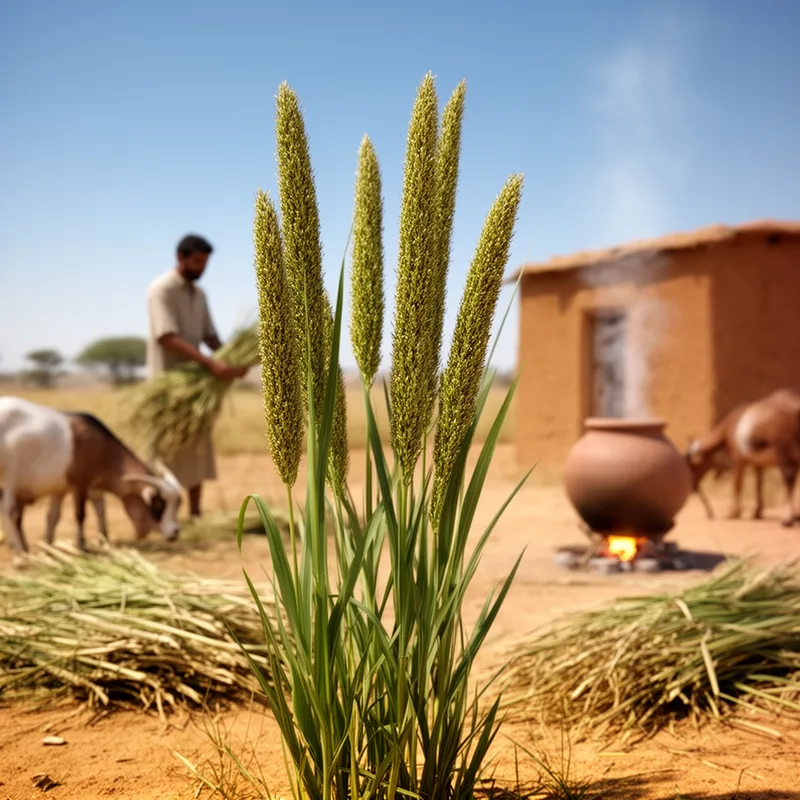
Pennisetum glaucum
- noun
- Specialized
- Pennisetum glaucum, commonly known as pearl millet, is a crucial crop in many African countries for its nutritious grains.
Examples
-
Pennisetum glaucum is widely cultivated across India and Africa as a staple grain.
-
Some traditional African beers are brewed using the grains of Pennisetum glaucum.
-
Farmers in arid regions often choose Pennisetum glaucum because of its drought tolerance.
-
Farmers in Africa often cultivate Pennisetum glaucum for its high yield.
-
Did you know that Pennisetum glaucum is also known as pearl millet?
-
In regions with low rainfall, Pennisetum glaucum stands out for its ability to thrive and provide essential forage.
-
Many people enjoy dishes made with Pennisetum glaucum due to its versatility in cooking and brewing.
Synonyms
A tall grass grown for grain used for food, animal feed and making beer
Surface Forms
Morphology
Pennisetum + glaucum
This is a Latin scientific binomial rather than a compositional English phrase; knowing 'Pennisetum' as a grass genus (and even knowing 'glaucum' as a Latin descriptor) does not enable a B1 learner to infer the common plant identity, uses, or meaning 'pearl millet'. The term functions as a technical name whose referent and usage are lexicalized and language-specific, so its meaning is not derivable from the constituents.
Etymology
Pennisetum glaucum may come from Latin words that describe how it looks: Pennisetum from 'feather' because its seed heads look like little feathers, and glaucum from 'blue-grey' for its pale leaves. So the name helps you picture this tall grass grown for its grain.

