
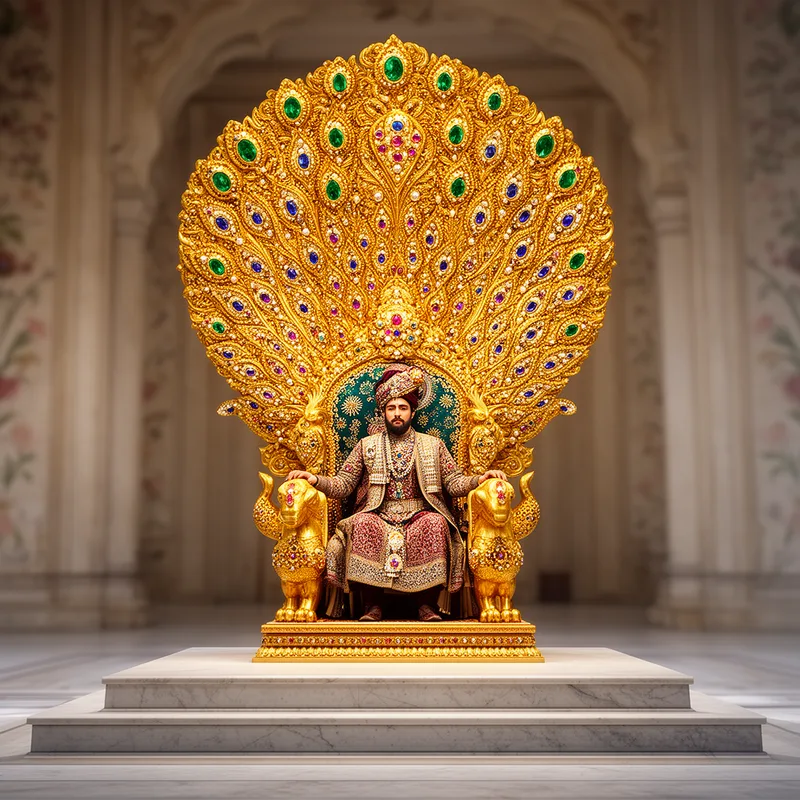
Peacock Throne
- noun
- Many artists have depicted the Peacock Throne in their works, highlighting its intricate beauty and historical importance.
Examples
-
Historically significant, the Peacock Throne was a lavish display of royal power in India before it was taken to Persia.
-
[Abdul] Shah Jahān also built the Red Fort, the Gardens of Shalimar, the Peacock Throne.
-
What happened to the Peacock Throne?
-
The Peacock Throne?
-
But the pièce de résistance is the Peacock Throne.
-
The Peacock Throne, adorned with precious gems and gold, symbolizes the opulence of the Mughal emperors.
Synonyms

 65
4.1
65
4.1

A special chair for a king or bishop that shows power

A decorated cushioned seat that a prince sits on in a royal court
Surface Forms
Morphology
A B1 learner who knows 'peacock' and 'throne' can reasonably infer a throne associated with peacock imagery or ornamentation, so the compositional sense is partially transparent. However 'Peacock Throne' is a specific historical proper name with cultural and historical significance (Mughal imperial seat) that cannot be fully derived from the constituents, so the overall meaning is not fully predictable.
Etymology
The Peacock Throne was a famous golden throne in the court of the Mughal emperors in India, decorated with carved peacocks and many jewels. When Persian forces took it in 1739, it became a 'symbol' of royal power in Iran, so the name now stands for 'royal authority'.