
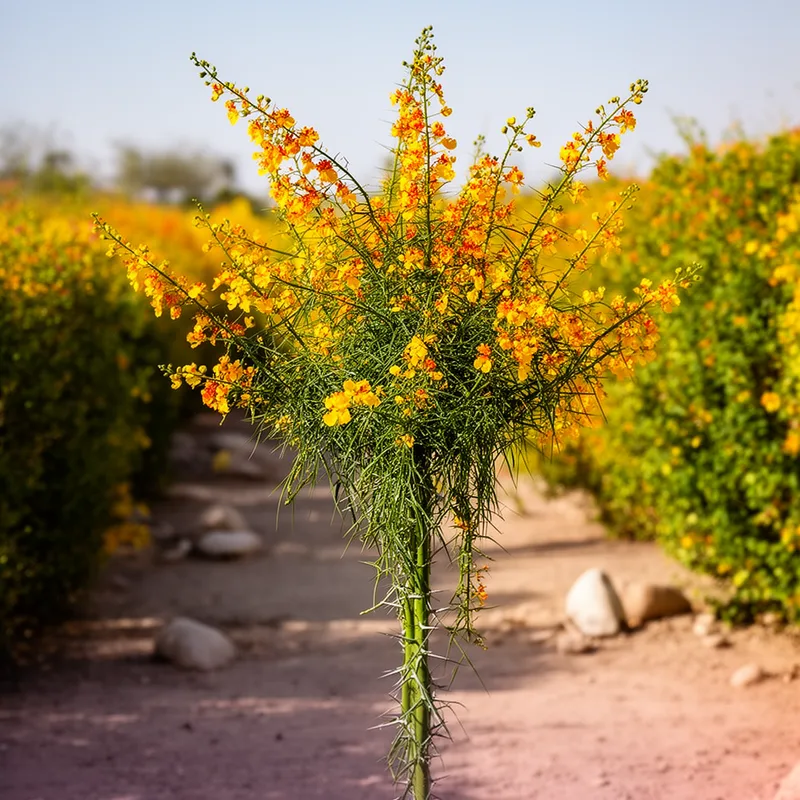
Parkinsonia aculeata
- noun
- Specialized
- Gardeners appreciate Parkinsonia aculeata for its resilience and striking yellow-orange flowers.
Examples
-
Some ranchers plant Parkinsonia aculeata as an emergency food source for their livestock.
-
The arid landscape was dotted with Parkinsonia aculeata trees in full bloom.
-
Look at the stunning Parkinsonia aculeata in the park!
-
The Parkinsonia aculeata is known for its beautiful yellow-orange flowers.
-
Some ranchers plant Parkinsonia aculeata as an emergency food source for their livestock.
-
Gardeners appreciate Parkinsonia aculeata for its resilience and striking yellow-orange flowers.
-
The arid landscape was dotted with Parkinsonia aculeata trees in full bloom.
Synonyms

A large spiny shrub or small tree with yellow orange flowers used as a hedge and for animal food

A thorny shrub or small tree with yellow flowers often grown in warm, dry places
Surface Forms
Morphology
Parkinsonia + aculeata
This is a scientific binomial combining a genus name (Parkinsonia) with a Latin species epithet (aculeata). If a learner knew both constituents and recognized that 'aculeata' means 'spiny/prickly', the meaning ('a spiny Parkinsonia shrub') would be compositional; however, the epithet is Latin/technical and the naming convention is specialist, so the sense is not fully predictable for an average B1 learner without domain knowledge.
Etymology
Parkinsonia aculeata may come from a plant expert's name (Parkinsonia) plus the Latin word aculeata meaning 'spiny'. The name paints a clear picture of a small tree with sharp spines and bright yellow flowers, so it helps you remember this 'spiny' shrub often grown in gardens or used as emergency animal food.

