
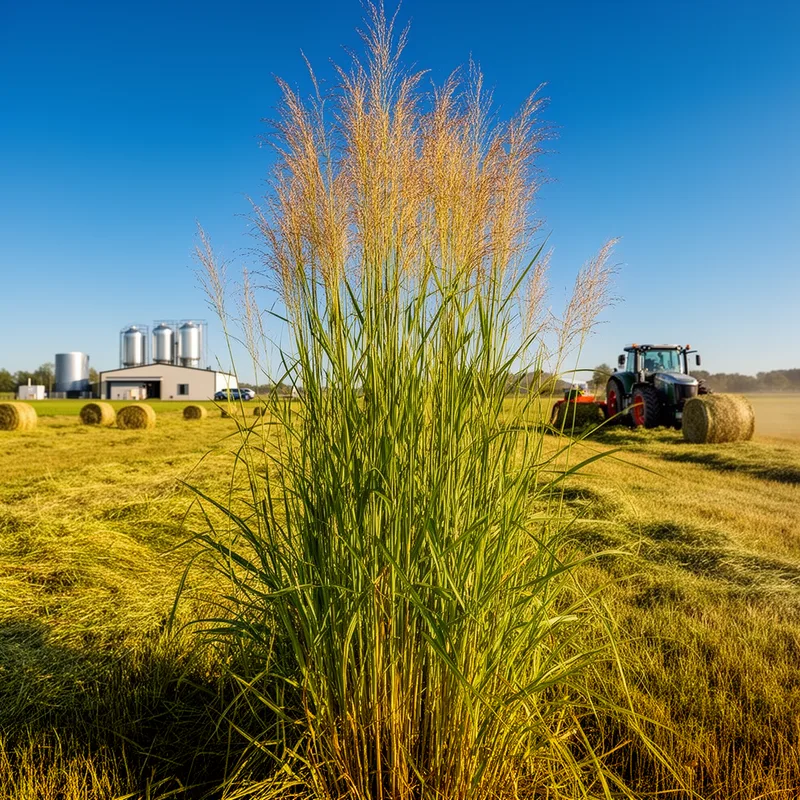
Panicum virgatum
- noun
- /ˈpænɪkəm vɪrˈɡeɪtəm/
- Specialized
- Panicum virgatum is commonly used for hay and provides excellent forage for livestock.
Examples
-
Many biofuel researchers are studying Panicum virgatum as a renewable energy source.
-
Farmers often grow Panicum virgatum in areas prone to erosion due to its deep root system.
-
Panicum virgatum is widely cultivated for its use as forage and in soil conservation projects.
-
Farmers often grow Panicum virgatum for its high yield.
-
Did you know that Panicum virgatum is a drought-resistant grass?
-
Due to its ability to thrive in poor soil, Panicum virgatum is a popular choice for land restoration.
-
Many farmers plant Panicum virgatum to improve soil health and as a sustainable bioenergy crop.
Synonyms
 2
6.6
2
6.6

A tall North American grass that farmers grow for fuel, animal food, and to help wildlife
Surface Forms
Morphology
Panicum + virgatum
This is a Latin binomial (scientific name) rather than a compositional English phrase; the genus + species format is a taxonomic label whose specific meaning (the plant switchgrass, its uses and properties) is lexicalized and not derivable from everyday English words. Even if a learner knows 'Panicum' as a grass genus, the species epithet 'virgatum' is a Latin morphological element (not a familiar English word) and does not transparently convey the full referent or usage, so the expression is effectively opaque to a B1 learner.
Etymology
Panicum virgatum comes from old Latin words: Panicum for a kind of grass and virgatum from a word for a thin 'rod' or 'switch'. That's why the name gives the picture of long, straight stems and fits this tall grass people grow for hay, to stop soil washing away, and to make fuel.