
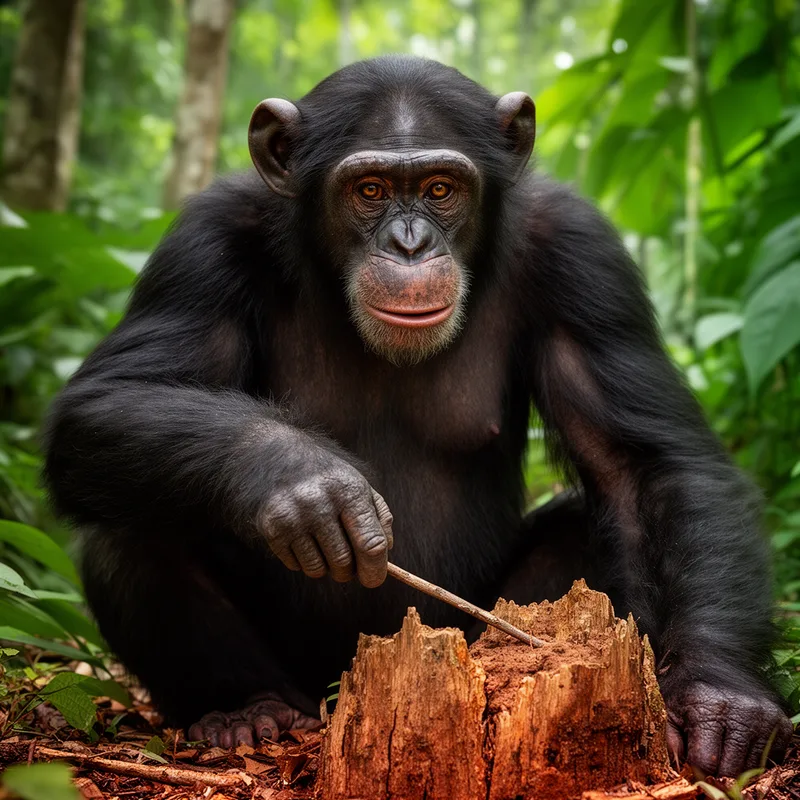
Pan troglodytes
- noun
- /pæn trɒɡləˈdaɪtiːz/
- Specialized
- Pan troglodytes often make forays along the borders of neighboring territories, where they castrate or kill resident males.
- chimpanzee (Pan troglodytes)
Examples
-
The social structures of Pan troglodytes include complex relationships and communication methods among group members.
-
In the forests of Africa, Pan troglodytes have been observed using tools to obtain food.
-
Key words: sexual selection; human evolution; Pan troglodytes; eusociality; sterile castes
Academic text (2014) -
Chimpanzees (Pan troglodytes) feed on ripe mangoes, already fallen to the ground.
Academic text (2004) -
The common chimpanzee, Pan troglodytes troglodytes, has so far been the only species found to carry the SIV that becomes HIV-1 when transmitted to humans.
Academic text (2004) -
Researchers have found that Pan troglodytes can recognize themselves in mirrors, indicating high intelligence.
Synonyms

 297
2.4
297
2.4

A large smart ape from African forests that is close to humans
 77
2.6
77
2.6
A large smart ape from African forests that is closely related to humans
Surface Forms
Morphology
This is a scientific binomial name rather than a compositional English phrase; knowing 'Pan' (a genus name) and 'troglodyte' (cave-dweller) does not lead a B1 learner to the everyday meaning 'common chimpanzee' and in fact the literal sense ('cave-dweller') is misleading. Taxonomic Latinized names are arbitrary labels and their referents are not predictable from the ordinary English meanings of their parts.
Etymology
Pan troglodytes is the scientific name that may come from older words: Pan names the ape group and troglodytes is an old word meaning 'cave dweller', because early writers thought these apes lived in caves. So the name points to the animal we now call the common 'chimpanzee'.