
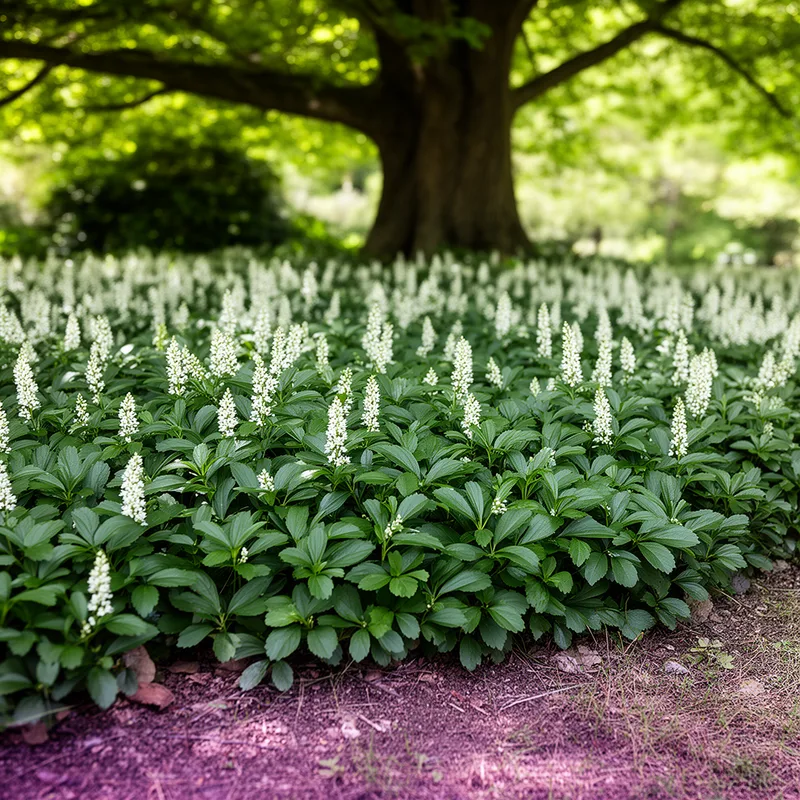
Pachysandra terminalis
- noun
- Specialized
 :
Pachysandra terminalis
:
Pachysandra terminalis
- For shaded borders, gardeners often choose Pachysandra terminalis because of its attractive evergreen leaves.
Examples
-
The white flower spikes of Pachysandra terminalis bloom in early spring.
-
Pachysandra terminalis forms a dense mat that keeps weeds at bay in shady garden areas.
-
The garden is filled with Pachysandra terminalis.
-
Have you seen the Pachysandra terminalis blooming?
-
Pachysandra terminalis is commonly used as a ground cover for shaded areas in residential gardens.
-
Gardeners appreciate Pachysandra terminalis for its ability to thrive in low light while providing year-round greenery.
-
In spring, the beautiful white flowers of Pachysandra terminalis create a lovely display in shaded landscapes.
Synonyms

A low evergreen plant used as ground cover with small white flowers
Surface Forms
Morphology
This is a Latin binomial combining the genus name 'Pachysandra' with the specific epithet 'terminalis' ("situated at a tip"). A learner who knows both constituents can infer it denotes a particular species of Pachysandra characterized by a terminal feature (e.g., terminal flower spikes), but the detailed botanical description (native range, growth rate, groundcover habit) cannot be fully derived from the parts. The taxonomic compositional pattern is cross-linguistically regular but technical, giving partial rather than full transparency.
Etymology
Pachysandra terminalis comes from old Greek and Latin words: Greek pachy means 'thick' and Greek andra refers to the male parts inside the flowers, while Latin terminalis means 'at the end'. So the name gives a clear picture — the plant has thick little parts in its flowers and white flower spikes that grow at the ends of the stems, which helps explain the name today.

