
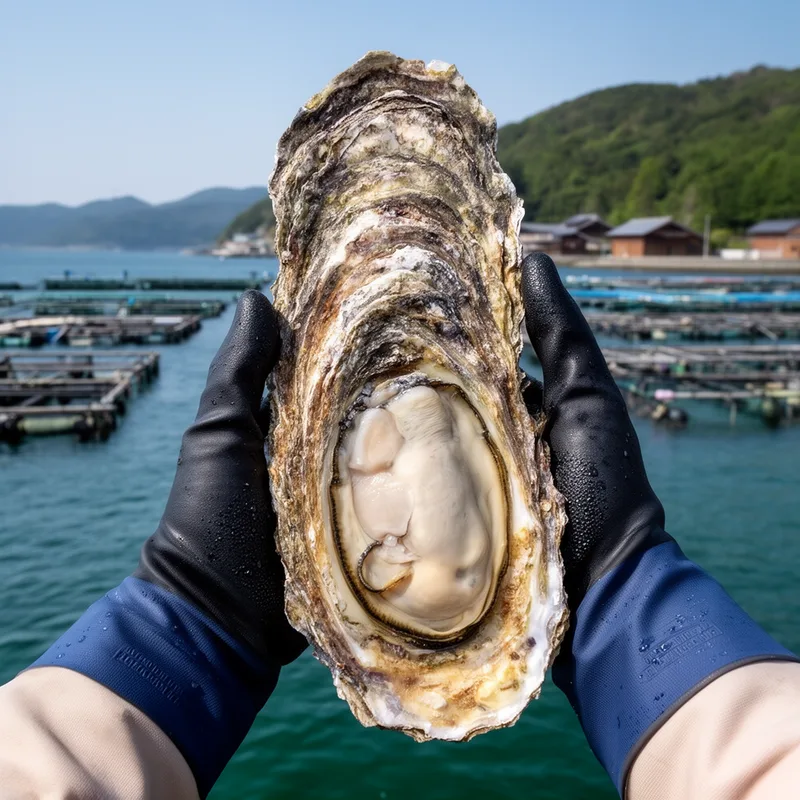
Ostrea gigas
- noun
- /oʊˈstriːə ˈɡiːɡəs/
- Specialized
 :
Ostrea gigas
:
Ostrea gigas
- Scientists are studying the impact of Ostrea gigas on local ecosystems in the Pacific Northwest.
Examples
-
The Ostrea gigas has become widely cultivated in aquaculture due to its rapid growth.
-
The chef prepared a delicious dish using Ostrea gigas.
-
Many seafood restaurants now serve Ostrea gigas as a delicacy, often labeling it as 'Pacific oyster.'
-
Have you ever tasted Ostrea gigas?
-
Many seafood restaurants now serve Ostrea gigas as a delicacy, often labeling it as 'Pacific oyster.'
-
Scientists are studying the impact of Ostrea gigas on local ecosystems in the Pacific Northwest.
-
The Ostrea gigas has become widely cultivated in aquaculture due to its rapid growth.
Synonyms

A large edible oyster from Japan often grown on farms
Surface Forms
Morphology
Ostrea + gigas
This is a Linnaean binomial combining the genus name Ostrea (a group of true oysters) with the specific epithet gigas, which conventionally means ‘large/giant’ in taxonomic Latin/Greek; together they transparently denote a large oyster species. Although 'gigas' may not appear in everyday dictionaries, the compositional pattern of genus + descriptive epithet is regular and cross-linguistically recognizable, so a learner who knows both constituents would infer the meaning.
Etymology
Ostrea gigas comes from old Latin and Greek words: Ostrea means 'oyster' and gigas means 'giant' or 'large'. So, the name describes a big oyster and that is why it is used for the large Pacific oyster species.

