
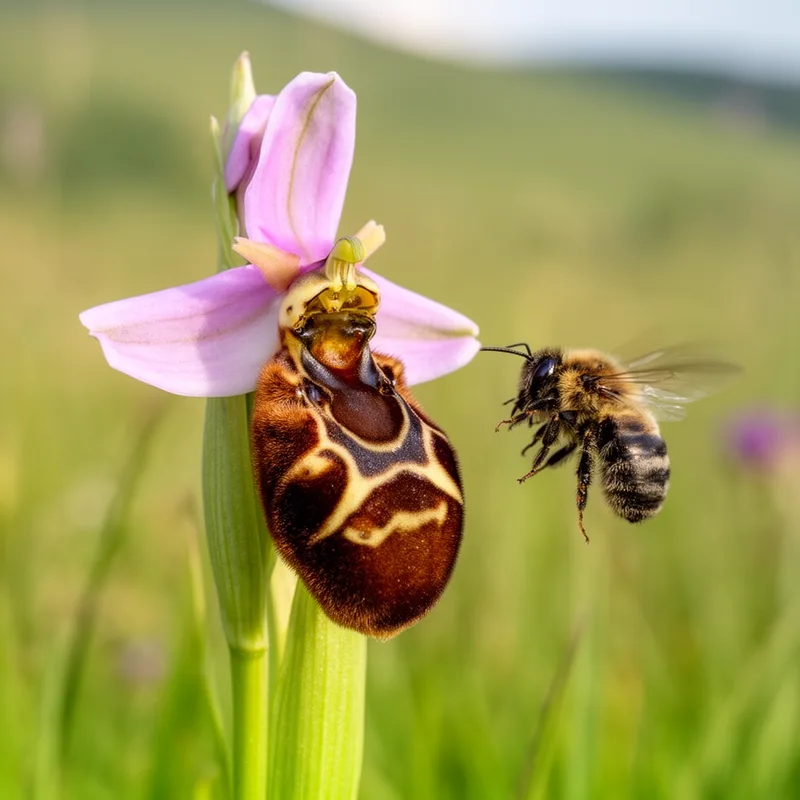
Ophrys apifera
- noun
- Specialized
- The Ophrys apifera attracts pollinators by mimicking the appearance of a bumble bee.
Examples
-
In some regions, Ophrys apifera can be found growing wild in meadows and grassy slopes.
-
The Ophrys apifera blooms in late spring.
-
Botanists admire the unique evolutionary adaptation of Ophrys apifera's flower shape and coloration.
-
Have you ever seen an Ophrys apifera in the wild?
-
The Ophrys apifera is often characterized by its flowers that look strikingly like bumble bees.
-
During a nature walk, we spotted an Ophrys apifera among the wildflowers in the meadow.
-
Many gardeners choose to plant Ophrys apifera for its unique bumble bee-like flowers.
Synonyms

A European wild flower whose bloom looks like a bumblebee
Surface Forms
Morphology
Ophrys + apifera
This is a Latin scientific name made of a genus (Ophrys) and a species epithet (apifera); neither element is a common English lexical item a B1 learner would know, and 'apifera' is not transparently interpretable without knowledge of Latin morphemes (api- = bee, -fera = bearing). Recognizing it as ‘bee orchid’ therefore requires specialist botanical or Latin knowledge beyond a typical B1 learner, so the meaning is not derivable from the constituents.
Etymology
Ophrys apifera gets its name from old Greek and Latin words: Ophrys points to the flower's curved, brow-like lip and apifera means 'bee-bearing'. The name paints a clear picture — the flower looks like a 'bee', and that is why it attracts real bees.

