
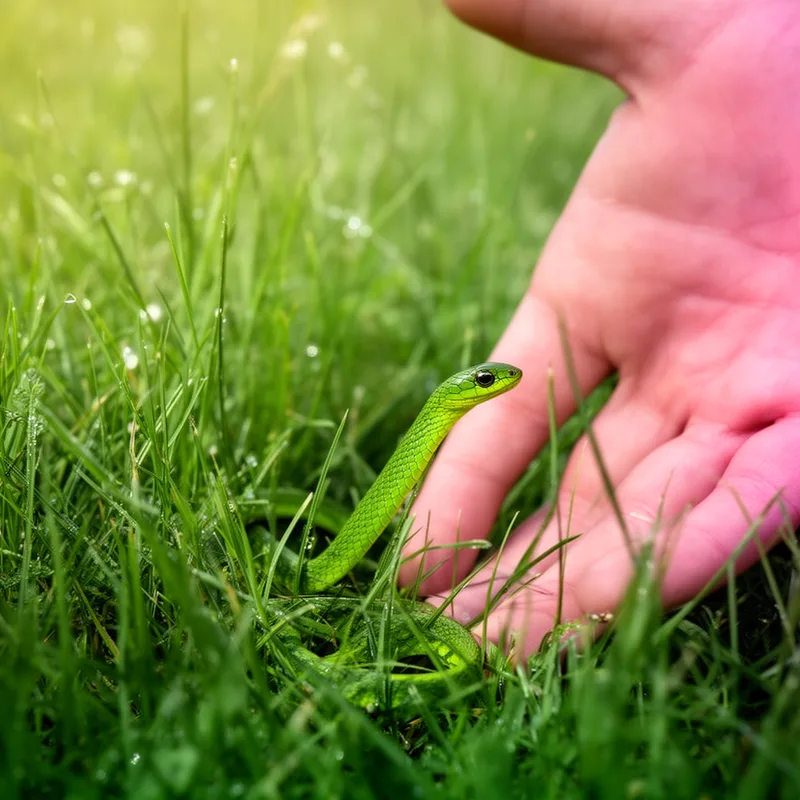
Opheodrys vernalis
- noun
- /oʊˈfiːəˌdraɪs vərˈneɪlɪs/
- Specialized
- The Opheodrys vernalis is commonly found in moist meadows and grassy areas.
Examples
-
Unlike some other snakes, the Opheodrys vernalis is harmless to humans.
-
Herpetologists conducted a survey on the population of Opheodrys vernalis in the region.
-
The Opheodrys vernalis is often found in grassy areas.
-
Have you ever seen an Opheodrys vernalis in the wild?
-
Herpetologists documented the habitat preferences of the Opheodrys vernalis in the natural reserves.
-
The Opheodrys vernalis is known for its vibrant green color and is often seen basking in the sun.
-
In the spring, the Opheodrys vernalis emerges from hibernation and can be spotted in sunny fields.
Synonyms

A thin snake with smooth green scales, not poisonous, living in meadows and open woods in the United States
Surface Forms
Morphology
Opheodrys + vernalis
This is a Latin binomial (a taxonomic proper name) rather than a compositional English phrase; the parts function as a scientific label (genus + species) and do not transparently encode the common-language meaning 'smooth green snake' for a B1 learner. Even if a learner knew the genus label 'Opheodrys', species epithets like 'vernalis' are not regular English vocabulary and the overall referent is an arbitrary name, so the meaning cannot be derived from the parts.
Etymology
Opheodrys vernalis may come from old word parts: Opheodrys meaning 'tree snake' and vernalis meaning 'of spring', because these small green snakes live in grass and low plants and are often seen in spring. So the name helps you remember it is a small, smooth green snake active in the spring.

