

Oncorhynchus tshawytscha
- noun
- /ˌɒŋkəˈrɪŋkəs tʃəˈwɪtsʧə/
- Specialized
- The Oncorhynchus tshawytscha, also called king salmon, is valued for its rich flavor and nutritional benefits.
Examples
-
The Oncorhynchus tshawytscha is prized by anglers for its impressive size and strength.
-
Fisheries in Alaska heavily depend on the annual migration of Oncorhynchus tshawytscha for commercial harvests.
-
After spawning, the Oncorhynchus tshawytscha die, completing their remarkable life cycle.
-
The Oncorhynchus tshawytscha is known for its rich flavor.
-
Have you ever tasted Oncorhynchus tshawytscha?
-
Fisheries in Alaska rely on the annual migration of Oncorhynchus tshawytscha for commercial harvests.
-
After spawning, adult Oncorhynchus tshawytscha complete their life cycle, returning to the place they were born.
Synonyms

 3
8.0
3
8.0

A large salmon from the Pacific Ocean often eaten as food


 1
3.5
1
3.5
A very large Pacific salmon valued as food that dies after spawning

A large Pacific fish eaten as food that dies after laying eggs
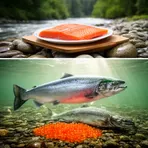
A large Pacific fish eaten for its rich meat that lays eggs and then dies
Surface Forms
Morphology
Oncorhynchus + tshawytscha
This is a Latin binomial: the genus 'Oncorhynchus' labels a group of salmon but the specific epithet 'tshawytscha' is not a normal English word and carries no compositional meaning a B1 learner could use. Scientific species names are essentially arbitrary, language-neutral labels, so their full referent ('king/Chinook salmon, a large Pacific salmon') cannot be derived from the parts.
Etymology
Oncorhynchus tshawytscha comes from older words that give a simple picture. The first part, Oncorhynchus, joins words for hook and nose, like the hooked jaw male salmon grow when they lay eggs, and the second part, tshawytscha, comes from a local native name for the 'Chinook' or 'king salmon', so the full name points to the large, famous salmon we know today.