
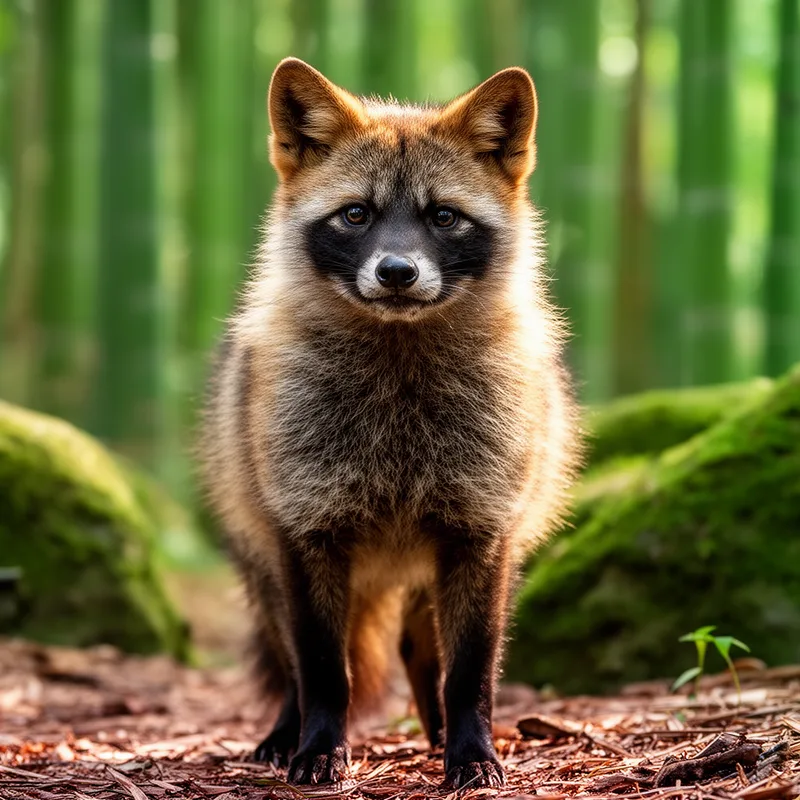
Nyctereutes procyonides
- noun
- /nɪkˈtɛrjuːtɪs proʊˌsaɪəˈnaɪdiːz/
- Specialized
- The Nyctereutes procyonides is often referred to as the raccoon dog due to its distinctive facial markings.
Examples
-
Unlike true raccoons, Nyctereutes procyonides belongs to the canine family.
-
Researchers have observed Nyctereutes procyonides in both wild and urban environments across eastern Asia.
-
The Nyctereutes procyonides is often found in forested areas.
-
Have you ever seen a Nyctereutes procyonides in the wild?
-
The Nyctereutes procyonides is known for its unique appearance, resembling a blend of a raccoon and a dog.
-
In the forests of Japan, the Nyctereutes procyonides can be seen foraging for food at dusk.
-
Naturalists often study the Nyctereutes procyonides to understand its behavior and habitat preferences.
Synonyms

A small wild dog from eastern Asia with dark face markings like a raccoon
Surface Forms
Morphology
Nyctereutes + procyonides
This is a Latin taxonomic binomial rather than a compositional English phrase; its parts are scientific names (one of which is not even defined here), not everyday English words. Even if a learner knows the genus gloss, a B1 learner would not reliably infer the common name 'raccoon dog' or the specific meaning from the constituent forms. Therefore the expression is effectively idiomatic/terminological and not transparently derivable from its parts.
Etymology
Nyctereutes procyonides comes from Greek words: Nyctereutes means 'night wanderer' and procyonides means 'raccoon-like'. So the name gives the image of a dog-like animal that moves at night and looks like a raccoon, which is why we call it the 'raccoon dog' today.

