
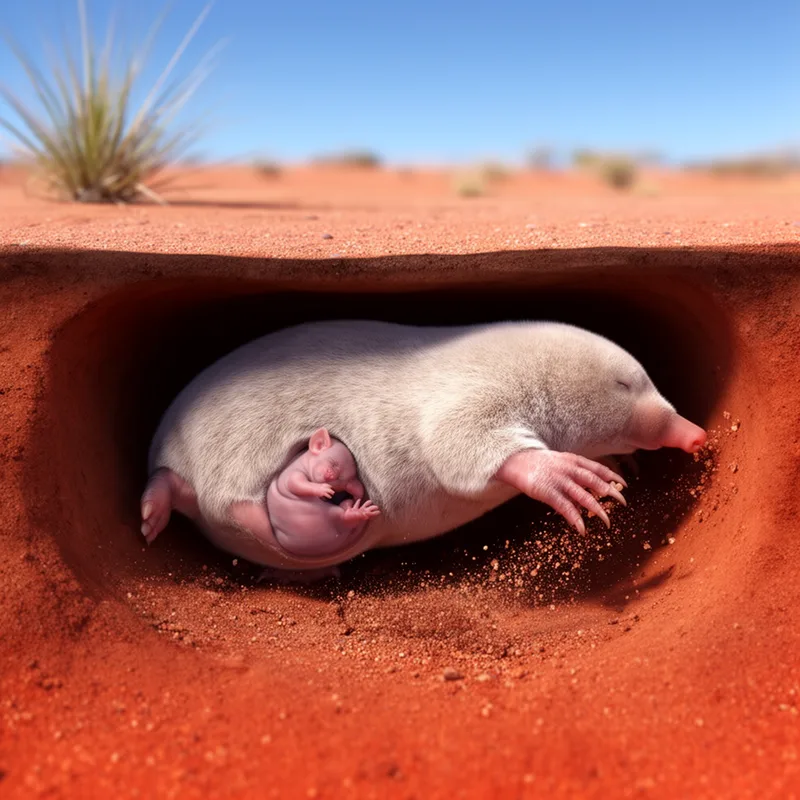
Notoryctus typhlops
- noun
- Specialized
- Unlike true moles, Notoryctus typhlops is a marsupial and possesses a pouch for its young.
Examples
-
The habitat of Notoryctus typhlops consists mainly of loose, sandy soils ideal for burrowing.
-
Researchers discovered a Notoryctus typhlops beneath the sandy desert surface in Western Australia.
-
The Notoryctus typhlops is unique to Australia.
-
Did you know that the Notoryctus typhlops is a marsupial?
-
Scientists have studied the Notoryctus typhlops to learn more about its burrowing behavior in the Australian outback.
-
The Notoryctus typhlops can be found in areas with loose sandy soil, which it uses to create extensive tunnels.
-
Because of its unique adaptations, the Notoryctus typhlops thrives in arid environments where other mammals struggle.
Surface Forms
Morphology
Notoryctus + typhlops
This is a taxonomic Latin binomial (a scientific name) rather than a compositional English phrase; one constituent is not a standard English word and the name functions as a proper noun. A B1 learner who knows the listed constituents would not be able to derive 'a small burrowing marsupial native to Australia' from these parts, so the meaning is not transparently recoverable.
Etymology
Notoryctus typhlops may come from old Greek words: Notoryctus from words for 'south' and 'digger', and typhlops meaning 'blind'. So the name creates a clear image of a southern, burrowing animal that is nearly blind, which fits this marsupial mole that digs in sand and has little sight.

