
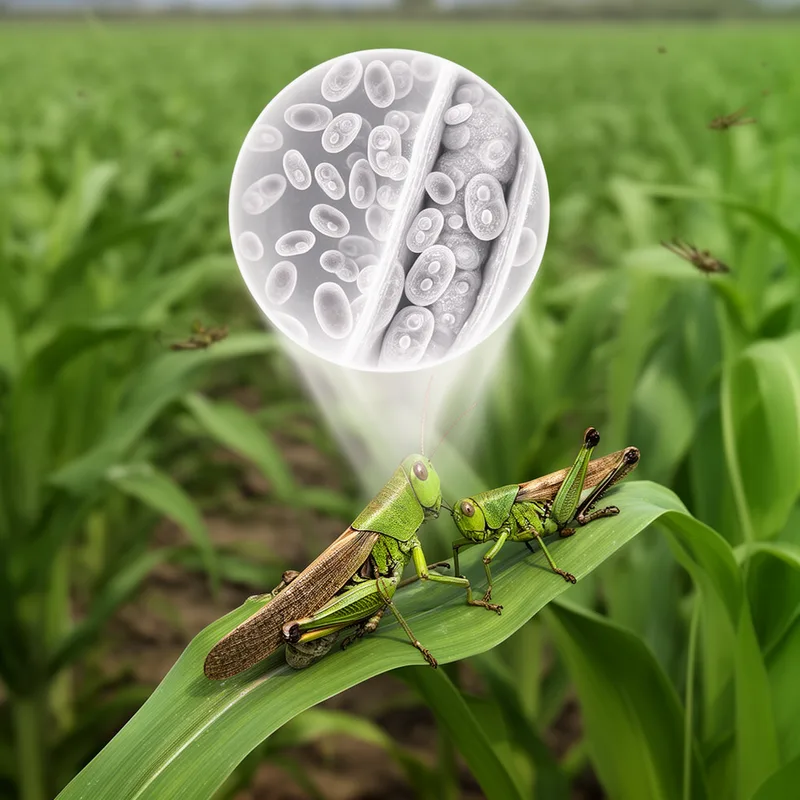
Nosema locustae


 1
9.9
- noun
- Specialized
- Farmers use Nosema locustae as a biological control to reduce grasshopper populations in their fields.
Examples
-
Researchers observed that Nosema locustae infection led to decreased feeding in several grasshopper species.
-
The spread of Nosema locustae can help manage pest outbreaks without chemical pesticides.
-
Farmers often use Nosema locustae to manage grasshopper outbreaks.
-
Have you heard about Nosema locustae as a biological control method?
-
Farmers use Nosema locustae as a biological control to reduce grasshopper populations in their fields.
-
Researchers observed that Nosema locustae infection led to decreased feeding in several grasshopper species.
-
The spread of Nosema locustae can help manage pest outbreaks without chemical pesticides.
Surface Forms
Morphology
Nosema + locustae
The name is a binomial taxonomic construction: 'Nosema' identifies the genus (a group of microsporidian parasites) and 'locustae' is a species epithet that signals association with locusts (Latin genitive). If a learner recognises the genus and the locust root and understands scientific naming, the meaning ('a Nosema species affecting locusts') is derivable; however, this inference depends on knowledge of biological naming conventions and Latin morphology, so it is not fully transparent to an average B1 learner.
Etymology
Nosema locustae may come from older words where Nosema meant 'disease' and locustae meant 'of locusts', giving the image of a tiny illness living in grasshoppers. So, the name fits: this tiny parasite is used to make grasshoppers sick and weak to help control them in fields.