

Nicotiana tabacum
- noun
- /ˌnɪkəˈteɪnə təˈbækəm/
- Specialized
- The leaves of Nicotiana tabacum are harvested and processed to produce cigarettes and cigars.
Examples
-
Scientists have studied Nicotiana tabacum to understand how nicotine is synthesized in plants.
-
The Nicotiana tabacum plant thrives in warm climates.
-
Most commercial tobacco products are made from Nicotiana tabacum, a species native to South America.
-
Farmers grow Nicotiana tabacum for its valuable leaves.
-
Most commercial tobacco products are made from Nicotiana tabacum, a species native to South America.
-
The leaves of Nicotiana tabacum are harvested and processed to produce cigarettes and cigars.
-
Farmers grow Nicotiana tabacum for its valuable leaves.
Synonyms


 1
3.4
1
3.4
A plant grown for its leaves that are dried and made into cigarettes or cigars
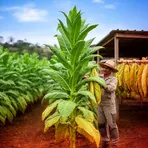
A tall South American plant grown for its large leaves used to make cigarettes and cigars
Surface Forms
Morphology
Nicotiana + tabacum
This is a Latin binomial (scientific) name and functions as a proper noun rather than a compositional English phrase; a B1 learner who knows the label 'Nicotiana' as a genus and an undefined epithet 'tabacum' would not reliably infer the specific meaning 'tobacco plant'. The sense is lexicalized botanical knowledge (or requires knowing that 'tabacum' = tobacco), so it is not transparently derivable from the constituents for most learners.
Etymology
Nicotiana tabacum is named after Jean Nicot, a French man who brought tobacco seeds to Europe in the 1500s. The parts Nicotiana (for Nicot) and tabacum (meaning 'tobacco') make it easy to remember that this is the plant used to make 'tobacco' products.