

Newton's third law of motion


 1
3.9
1
3.9
- noun
- /ˈnjuːtənz θɜrd lɔː ʌv ˈmoʊʃən/
- Specialized
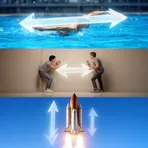
- When a swimmer pushes the water backward, they move forward due to Newton's third law of motion.
Examples
-
Can you explain Newton's third law of motion to me?
-
This experiment demonstrates Newton's third law of motion by showing that every action results in an equal and opposite reaction.
-
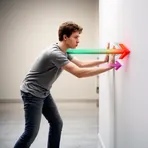
Children see Newton's third law of motion in action when they push against a wall and feel themselves move backwards.
-
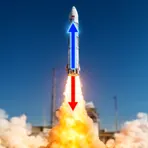
Rockets work thanks to Newton's third law of motion, as the hot gases push backward and the rocket moves forward.
-
When you jump off a boat, Newton's third law of motion explains why the boat moves in the opposite direction.
-
Wow! Newton's third law of motion explains so much about how we move!
-
According to Newton's third law of motion, when you push against a wall, the wall pushes back with equal force.
Synonyms
 1
4.1
1
4.1
When one object pushes another, the other object pushes back equally
 1
4.2
1
4.2
Every push on an object causes an equal push back in the opposite direction
 1
4.1
1
4.1
Every push or pull makes an equal force in the opposite direction
Surface Forms
Morphology
Newton's + third + law + of + motion
The components ('Newton's', 'third', 'law', 'of', 'motion') transparently indicate this is the third named scientific law concerning motion, so a B1 learner would infer it is a physics principle about movement. However, the specific content — that every action has an equal and opposite reaction — is conceptual and not derivable from the constituent words alone, so full meaning requires prior exposure or domain knowledge.
Etymology
The law Newton's third law of motion is easy to picture: if you push a wall, the wall pushes you back and you may move the other way. So it means every 'action' has an equal and opposite 'reaction'.