
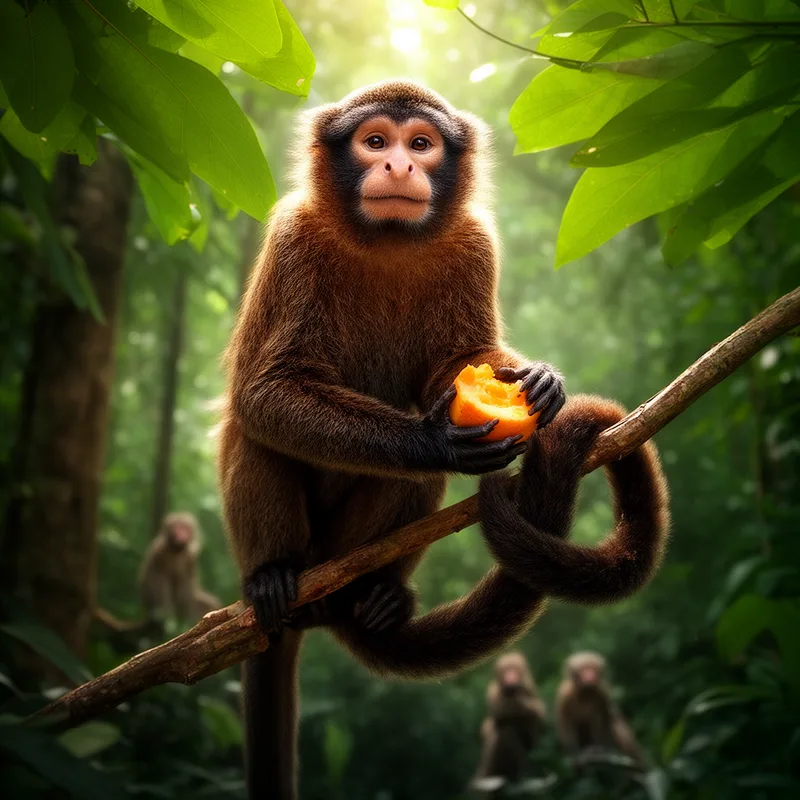
New World monkey
 1
5.9
1
5.9

- noun
- /nuː wɜrld ˈmʌŋki/
- US
- The bright colors of flowers attract New World monkeys, who play a role in pollination.
Examples
-
Many researchers study the social behavior of New World monkeys in their natural habitats.
-
The tropical tree-dwelling New World monkeys alone number some ninety species.
Academic text (2009) -
In mice, lemurs, and New World monkeys—almost all of which lack full color vision—the investigators noted that 18 percent of olfactory receptor genes are fossilized.
Academic text (2006) -
New World monkeys have prehensile tails that help them swing from tree to tree.
Synonyms
A monkey from Central or South America with wide nostrils and a tail that can hold things
A monkey from Central and South America with a broad, flat nose and a tail that can hold things
Surface Forms
Morphology
The head noun 'monkey' makes clear this is a kind or category of monkey, but the modifier 'New World' is a conventional proper-name for the Americas whose meaning is not transparently derivable from the words 'new' + 'world' for an average B1 learner. Because the phrase partly signals a subtype (geographic/biological) but relies on a lexicalized geographic term, the transparency is partial.
Etymology
New World monkey comes from early explorers who called the Americas the 'New World' and used that name for the monkeys they found there. These monkeys often have flat noses and a tail that can grab branches, so New World monkey means a monkey 'from the Americas', especially Central and South America.