

New World anteater
- noun
- /nuː wɜrld ˈæntiˌtɜr/
- US
- The New World anteater uses its long, sticky tongue to capture ants from their nests.
Examples
-
Unlike other mammals, the New World anteater has no teeth but a powerful sense of smell.
-
Conservationists studied the habitat of the New World anteater in the South American rainforest.
-
The New World anteater is known for its long snout.
-
Have you ever seen a New World anteater in the wild?
-
The New World anteater uses its long, sticky tongue to capture ants from their nests.
-
Conservationists studied the habitat of the New World anteater in the South American rainforest.
-
Unlike other mammals, the New World anteater has no teeth but a powerful sense of smell.
Synonyms

 2
2.0
2
2.0

A mammal from Central and South America with a long snout and tongue that eats ants and termites
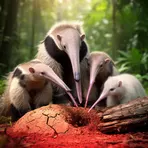
A group of mammals like anteaters that have long snouts and tongues for eating ants and termites
Surface Forms
Morphology
The head noun 'anteater' makes the basic meaning clear (a type of ant-eating mammal) and the phrase is compositionally a regional modifier + noun, so learners can infer it denotes a kind of anteater. However, 'New World' is a conventionalized geographic term meaning 'the Americas' whose specific sense is not fully predictable from 'new' + 'world' for a B1 learner, so the overall meaning is only partially derivable without prior exposure.
Etymology
New World anteater is a name that joins New World, meaning the 'Americas', and anteater, meaning an animal that 'eats ants'. The picture is simple: a long-tongued, often toothless mammal from the 'Americas' that eats ants and termites, so the name is used for those American mammals today.