
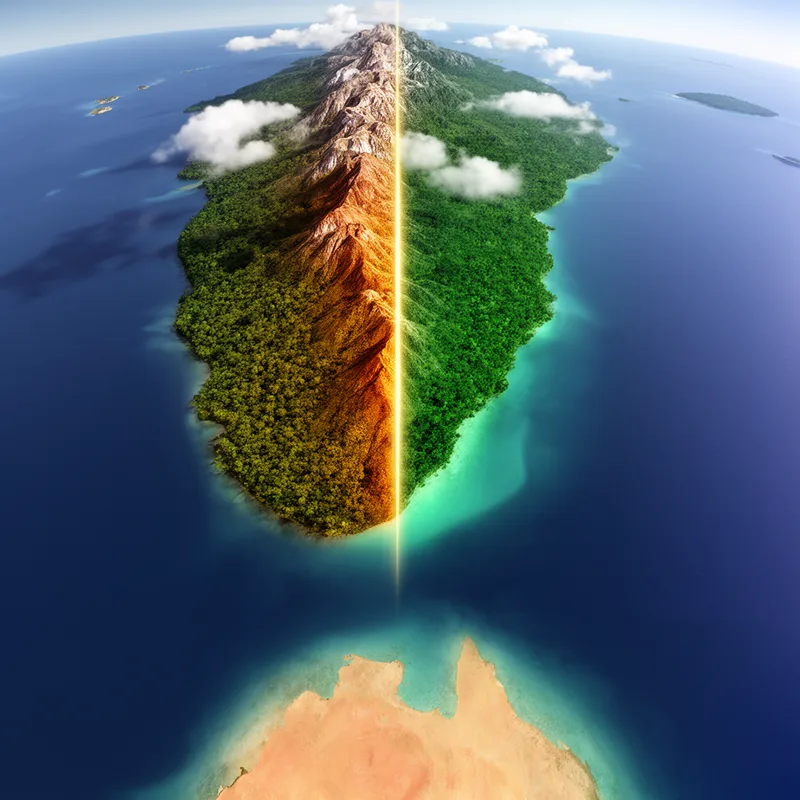
New Guinea
 32
3.0

- proper noun
- Many species of birds can only be found on the island of New Guinea.
- Papua New Guinea
- New Guinea, a country
Examples
-
We're headed to New Guinea to claim a fortune in gold!
-
No, mostly I dream of having a house in New Guinea.
-
This was as close as I could get to New Guinea.
-
Come with us to New Guinea.
-
What might you be doing here in New Guinea?
-
I found her in New Guinea.
-
We might have been in New Guinea by this time.
-
You ever been in New Guinea?
-
The troopship made a landfall in New Guinea, and our draft of seamen was set ashore.
Fiction book (1991) -
Current archaeological and genetic evidence points to the highlands of New Guinea, where bananas were deliberately planted at least as early as the first half of the fifth millennium B.C.
Academic text (2006)
Surface Forms
Morphology
New + Guinea
The form 'New' + 'Guinea' transparently signals a toponym built from a modifier and a place-name, so a learner will infer it denotes a place called Guinea (a 'new' Guinea). However, the specific facts that it is a large island north of Australia and its political division are not derivable from the constituents alone; knowing it refers to that particular island requires lexical/toponymic knowledge. The cross-linguistic pattern 'New + placename' is common, giving partial predictability but not full compositional meaning.
Etymology
New Guinea got its name from early European explorers. One popular story says the people and land there looked like the African place called 'Guinea', so the explorers added New to Guinea to name the island now north of Australia.