

Necturus maculosus
- noun
- /ˈnɛk.tʊr.əs mæk.jʊˈloʊ.səs/
- Specialized
- Unlike many amphibians, the Necturus maculosus retains its external gills throughout adulthood.
Examples
-
The Necturus maculosus spends its entire life in water and is often found under rocks in streams or lakes.
-
The Necturus maculosus is commonly known as the mudpuppy and can be recognized by its feathery gills and slimy skin.
-
Biologists conducted a study on the population decline of Necturus maculosus in the Great Lakes region.
-
The Necturus maculosus is often found in lakes and rivers.
-
Have you ever seen a Necturus maculosus in the wild?
-
In the wetlands, the Necturus maculosus can often be seen swimming gracefully near the bottom in search of food.
-
During the study, scientists noted that the Necturus maculosus prefers freshwater habitats with plenty of cover and hiding spots.
Synonyms

A large water salamander with feathery gills found in North America
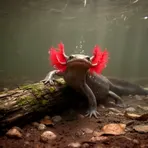
A large salamander with bushy red gills that lives in muddy water

A large salamander that lives in water in North America and has feathery gills
Surface Forms
Morphology
Necturus + maculosus
This is a scientific binomial (genus + species). Knowing 'Necturus' as the genus for mudpuppies lets a learner infer this is a species of that animal, but the specific epithet 'maculosus' is not defined here (and is Latin), so the precise common-name referent and descriptive detail are not fully predictable from the parts. Because the genus signals category but the species element and taxonomic convention require specialist knowledge, the expression is only partially transparent.
Etymology
The name Necturus maculosus comes from old Greek and Latin words. The part Necturus means 'swimmer' and maculosus means 'spotted', so the name gives a picture of a spotted animal that lives in water, the 'mudpuppy'.

