
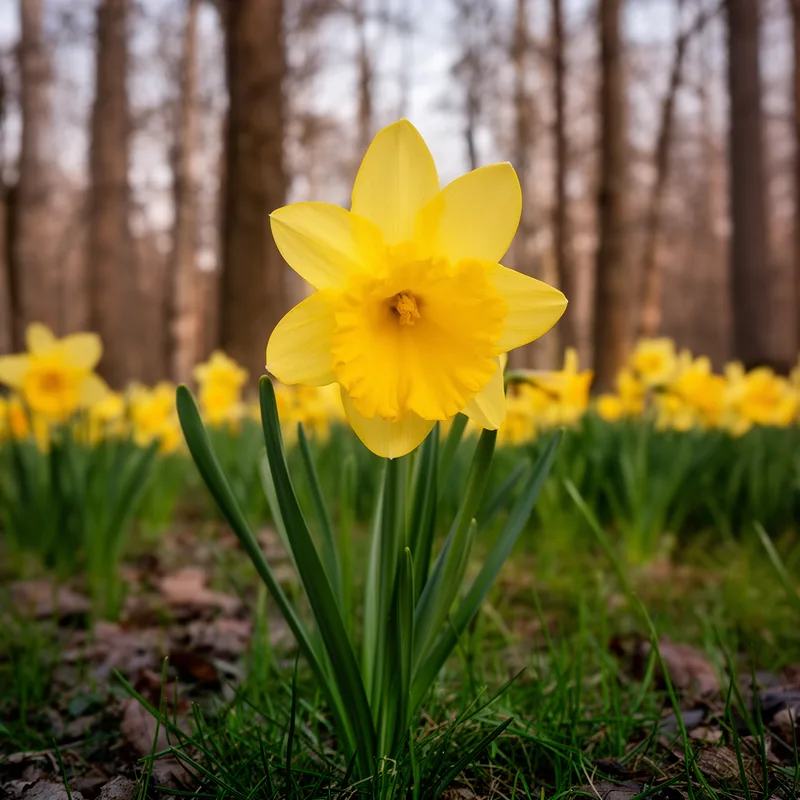
Narcissus pseudonarcissus
- noun
- Specialized
- The Narcissus pseudonarcissus is prized for its delicate yellow flowers and natural beauty.
Examples
-
Botanists study Narcissus pseudonarcissus to understand its role in the ecology of temperate woodlands.
-
Have you seen a Narcissus pseudonarcissus in the wild?
-
Every spring, the woods were carpeted with Narcissus pseudonarcissus in full bloom.
-
The Narcissus pseudonarcissus blooms beautifully in spring.
-
The garden was filled with beautiful Narcissus pseudonarcissus flowers, their bright yellow blooms swaying in the breeze.
-
Every spring, I eagerly await the arrival of Narcissus pseudonarcissus to herald the change in season.
-
During our nature walk, we spotted clusters of Narcissus pseudonarcissus along the woodland path, their trumpet-shaped flowers shining brightly.
Synonyms

 16
1.8
16
1.8

A spring flower that grows from a bulb with yellow or white petals and a trumpet-shaped center

 1
8.6
1
8.6
A yellow spring flower with a trumpet-shaped center
 1
7.2
1
7.2
A plant that grows from a bulb and has showy yellow or white flowers
Surface Forms
Morphology
Narcissus + pseudonarcissus
This is a Latin binomial (genus + specific epithet). A learner who knows 'Narcissus' and the common prefix 'pseudo-' ('false') can infer it refers to a Narcissus-related plant (i.e. some kind of daffodil), but the precise species identity and the common name 'wild daffodil' are not fully predictable from the parts alone. The structure is therefore partially transparent but requires botanical knowledge for exact meaning.
Etymology
Narcissus pseudonarcissus comes from the Greek myth of Narcissus, a young man who fell in love with his own reflection and turned into a flower, and from the word pseudo- meaning 'false'. So the name paints a clear picture: this bright yellow flower is a kind of 'false narcissus', which helps you remember it is the wild daffodil species.