
Namibian


 1
4.5
- noun
- /nəˈmɪbiən/
- Older musical traditions and crafts are becoming rarities, often unfamiliar to younger Namibians.
- Namibians against apartheid
- needs of Namibians
- many Namibians
Examples
-
Nearly 14,000 Namibians now work as fishers or in processing plants; none did before independence.
Academic text (2010) -
(b) Promoting and reinforcing cultural heritage and cultural expression: Namibians need to learn about and appreciate the diverse cultures indigenous to this country.
Academic text (2000) -
We further commit ourselves to cultural actions that will give all Namibians a sense of identity and belief in their own creative talent.
Academic text (2000) -
Since independence, however, Namibians have been encouraged to rediscover and celebrate their own cultures.
Academic text (2000) -
The practice of the arts forms an integral part of the lives of many Namibians that is rarely verbalized or analyzed.
Academic text (2000) -
The Constitution not only guarantees Namibians the more traditional rights protected by any number of the world's constitutions, but also deals with social, cultural, and economic rights.
Academic text (1991) -
As of 2003, Namibians held 162 out of the 163 permits to access fisheries.
Academic text (2010) -
A policy needs to represent the views, values, realities, and needs of Namibians, avoiding anyone's marginalization and exclusion.
Academic text (2000) -
Namibians released from imprisonment in Angola said they had been tortured, and more than 260 Namibians reportedly imprisoned in Angola could not be accounted for.
Academic text (1990) -
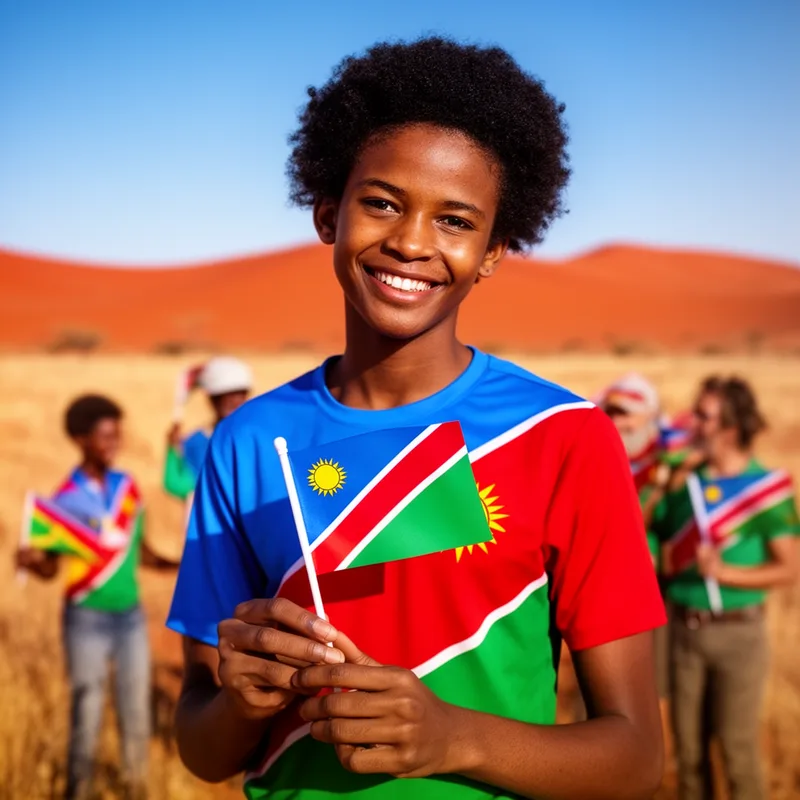
Many Namibians proudly share their cultural heritage during festivals and celebrations.
Surface Forms
Morphology
Etymology
The word Namibian comes from the country name Namibia, which itself comes from Namib, the name of the desert and a local word often said to mean 'vast place' or 'open land'. The ending -ian is a common English ending like in Canadian that means 'from or belonging to', so a Namibian is a person 'from Namibia'.