
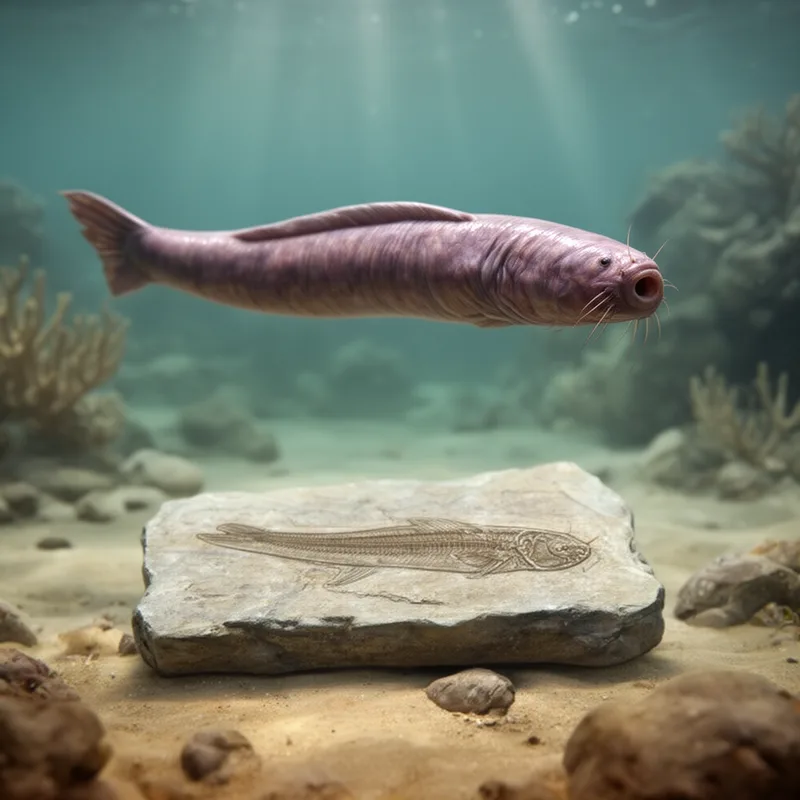
Myxinikela siroka
- noun
- Specialized
- The Pennsylvanian rock strata contained a remarkably well-preserved skeleton of Myxinikela siroka.
Examples
-
Fossils of Myxinikela siroka help scientists understand the evolution of jawless fishes.
-
Researchers discovered new features in Myxinikela siroka that link it to modern hagfish.
-
The Myxinikela siroka lived around 300 million years ago.
-
Did you know that Myxinikela siroka is a type of hagfish?
-
Fossils of Myxinikela siroka help scientists understand the evolution of jawless fishes.
-
Researchers discovered new features in Myxinikela siroka that link it to modern hagfish.
-
The Pennsylvanian rock strata contained a remarkably well-preserved skeleton of Myxinikela siroka.
Surface Forms
Morphology
Myxinikela + siroka
This is a Linnaean binomial (genus + species) composed of proper names rather than compositional English words; the second element 'siroka' is undefined and the form functions as an arbitrary taxonomic label. Because scientific names are essentially labels across languages and do not transparently encode the meaning 'extinct fossil hagfish', a B1 learner who knows the constituents would not be able to derive the MWE's meaning.
Etymology
Myxinikela siroka may come from the part Myxinikela, a word for 'slime', and the part siroka, a place or name, so the name gives the image of a long-ago hagfish that made slime. Fossils show it looked like modern hagfishes, so the name helps us remember it was an ancient 'jawless' fish.

